Entering the Uzbekistan Market in 2026: A Complete Guide for International Companies
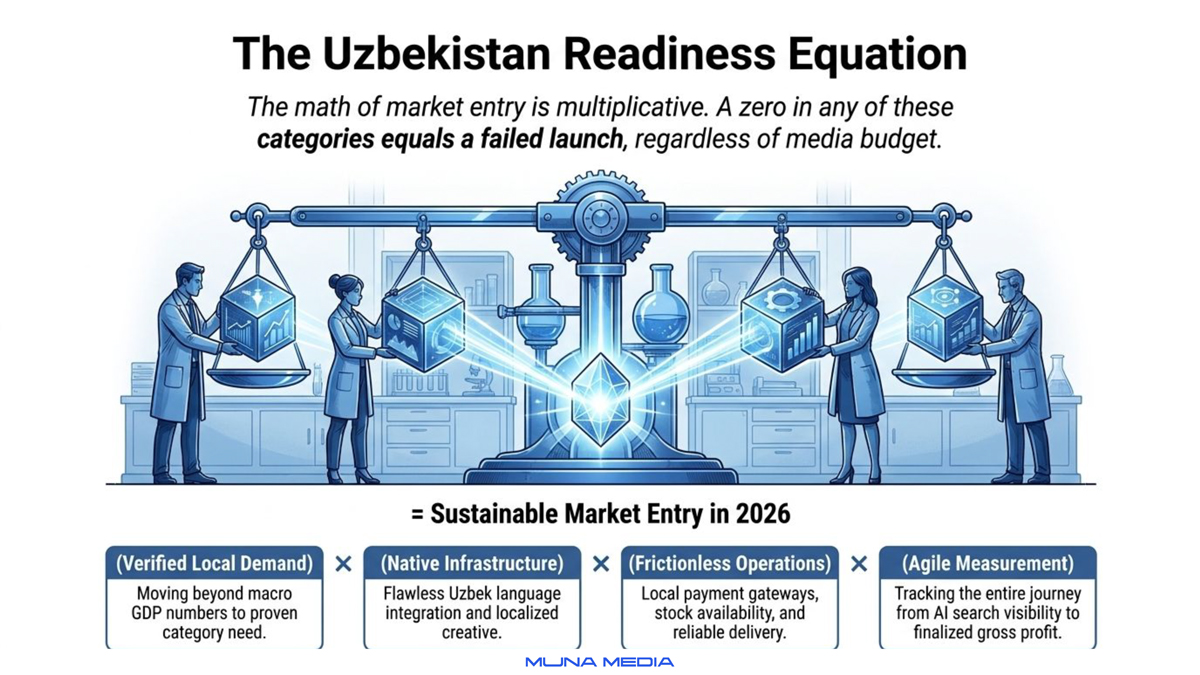
Uzbekistan is often described as Central Asia's largest consumer market. That is true by population, but population alone is not a market-entry case. The practical question is whether your company has a locally relevant offer, a viable route to the customer, working payments, measurable distribution, and the ability to comply with local requirements.
Uzbekistan's population exceeded 38.2 million as of 1 January 2026.[1] The World Bank projected 6.4% economic growth for 2026, while the International Monetary Fund projected 6.8%.[2][3] The country is young, fast-growing, and increasingly connected through digital channels. At the same time, media measurement is fragmented, audience estimates often conflict, and a playbook copied from Kazakhstan, Russia, Europe, or the Gulf is unlikely to work without adaptation.
This guide is for international and regional leaders who are:
assessing Uzbekistan as their first Central Asian market;
planning a Tashkent launch followed by regional expansion;
looking for a local strategy, media, and production partner;
validating demand before committing major capital;
already operating in Uzbekistan but unable to connect media activity to revenue;
building visibility not only in search, but also in AI-generated answers.
Short answer:
Uzbekistan can be a strong first market in Central Asia when a company values population scale, young consumers, and growing urban demand, and is prepared to localize the product and communication. Start with demand, language, price, payments, regulation, and availability, not with media buying.
Uzbekistan, 2026
Four signals that matter before launch
Official indicators are separated from estimates. Each card states the evidence type.
38.2m
Population
As of 1 January 2026.
Official statistics6.4-6.8%
Economic growth forecast
The range between the World Bank and IMF forecasts.
Two official forecasts33.1m
Internet users
DataReportal estimate for late 2025. Other methods produce different figures.
Estimate, not a censusUZ
Advertising language
Advertising must be disseminated in the state language, Uzbek.
Law on Advertising No. LRU-776
Bottom line: a large, growing market creates potential. The launch decision still depends on category demand, price, availability, and the ability to localize the product.
What decision-makers need to know first
1. A large population is not the same as an addressable market
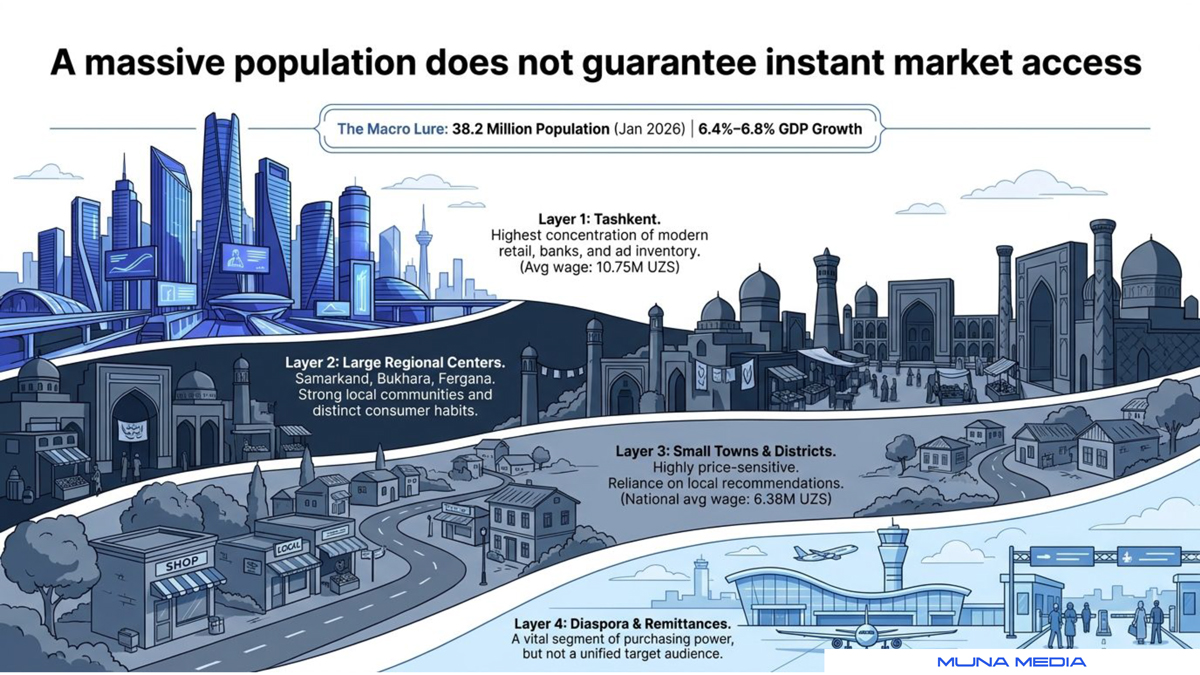
A population of more than 38.2 million creates scale, but it does not mean 38.2 million potential buyers. Purchasing power, distribution, language, and media habits vary considerably between Tashkent, major regional cities, and smaller communities.
A practical first segmentation includes at least four layers:
→ Tashkent: the country's highest income concentration and the largest cluster of modern retail, banks, new residential developments, restaurants, media inventory, and corporate buyers;
→ major regional cities: Samarkand, Bukhara, Fergana, Namangan, Andijan, and others, each with its own commercial patterns and local communities;
→ smaller cities and districts: lower average income, with price, recommendations, local points of sale, and delivery availability often playing a stronger role;
→ households receiving remittances: commercially relevant in selected categories, but not a single homogeneous segment.
The average accrued monthly wage for 2025 was reported at approximately UZS 6.38 million, while Tashkent was around UZS 10.75 million.[12] These averages should not be treated as a profile of the “typical buyer.” They hide substantial differences by industry, location, employment, and household structure.
2. Economic growth is a positive condition, not proof of category demand
The World Bank and IMF forecasts differ, but both indicate strong economic growth. For a commercial decision, the difference between 6.4% and 6.8% matters less than five category-specific questions:
Is your category growing?
How is the need being solved today?
What price range can the target buyer realistically accept?
Where does the buyer compare alternatives?
What blocks purchase: trust, price, availability, payment, delivery, or service?
Macroeconomic growth is context. A launch decision should be based on category evidence, field interviews, price testing, and a controlled pilot.
3. Uzbekistan is not a smaller version of a neighbouring market
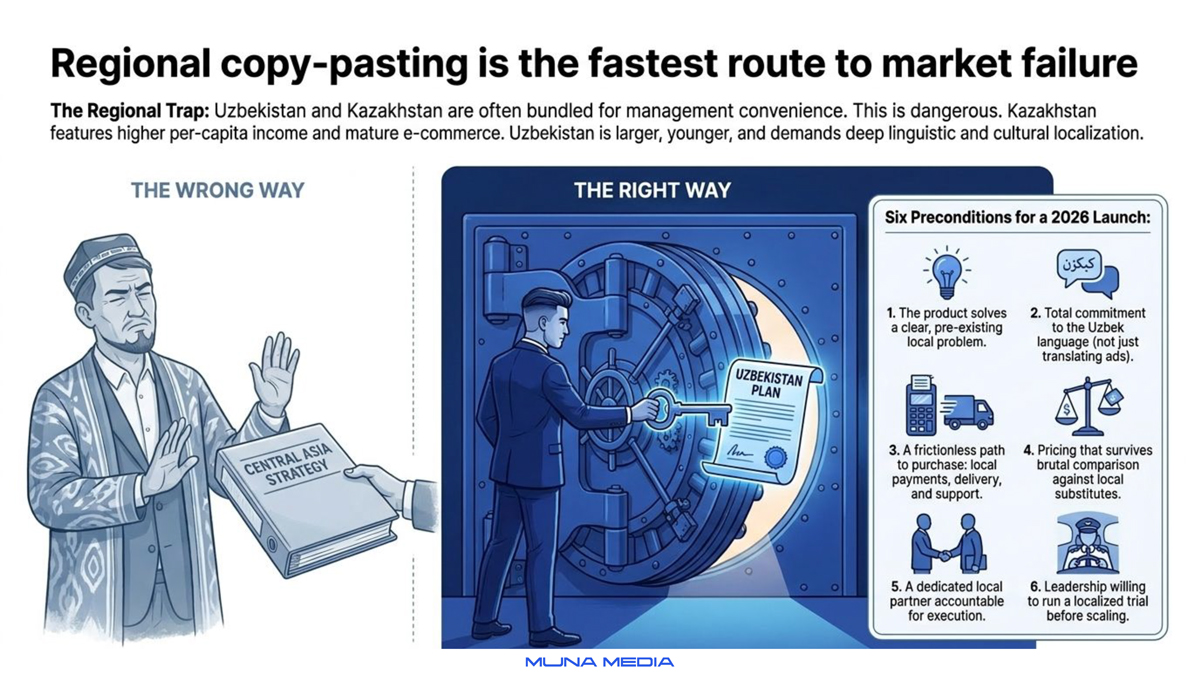
Uzbekistan and Kazakhstan are often grouped into one regional plan. That is convenient for management but risky for execution. Kazakhstan has higher per-capita income, more mature online commerce, and a different platform mix. Uzbekistan has the larger population, a younger demographic profile, and a stronger need for Uzbek-language localization.
A regional platform idea may travel. The same message, talent, media mix, and pricing usually should not.
When Uzbekistan should be your first Central Asian market
Uzbekistan is a plausible first market when at least four of the following are true:
the product solves an existing and clearly understood problem;
the company is ready to operate in Uzbek, not merely translate a few ads;
there is a complete path from communication to purchase, including stock, delivery, local payment, and support;
pricing can withstand comparison with local and regional alternatives;
a local team member or partner owns execution, not only advice;
management is willing to run a pilot and change the offer based on evidence;
the category does not depend on permits the company cannot yet obtain.
When to delay a major launch
Delay major spending when:
the decision-maker and user are not clearly defined;
supply and after-sales service are unstable;
local pricing is only a converted global price;
key materials and support are not available in Uzbek;
local buyers cannot use their preferred payment method;
a media budget exists, but research, production, and measurement do not;
regulatory conclusions are based on blog posts rather than primary law and local legal review.
Decision before media buying
Is the company ready to enter?
Score each area. If three or more sit in the red column, repair the foundation before scaling spend.
Area
Ready
Validate
Stop signal
Demand
Interviews and test enquiries exist
Only desk research exists
The case relies on population size
Proposition
Local problem and difference are clear
A global promise was translated
Value has not been tested with buyers
Price
Tested in UZS with full economics
Several assumptions exist
USD price was simply converted
Language
Uzbek version and editor are ready
Translation is in progress
Only Russian or English exists
Sales path
Stock, payment, and support work
Some stages remain untested
Advertising is ready before fulfilment
Measurement
Events run through to revenue
Enquiries are measured
Only impressions and clicks are tracked
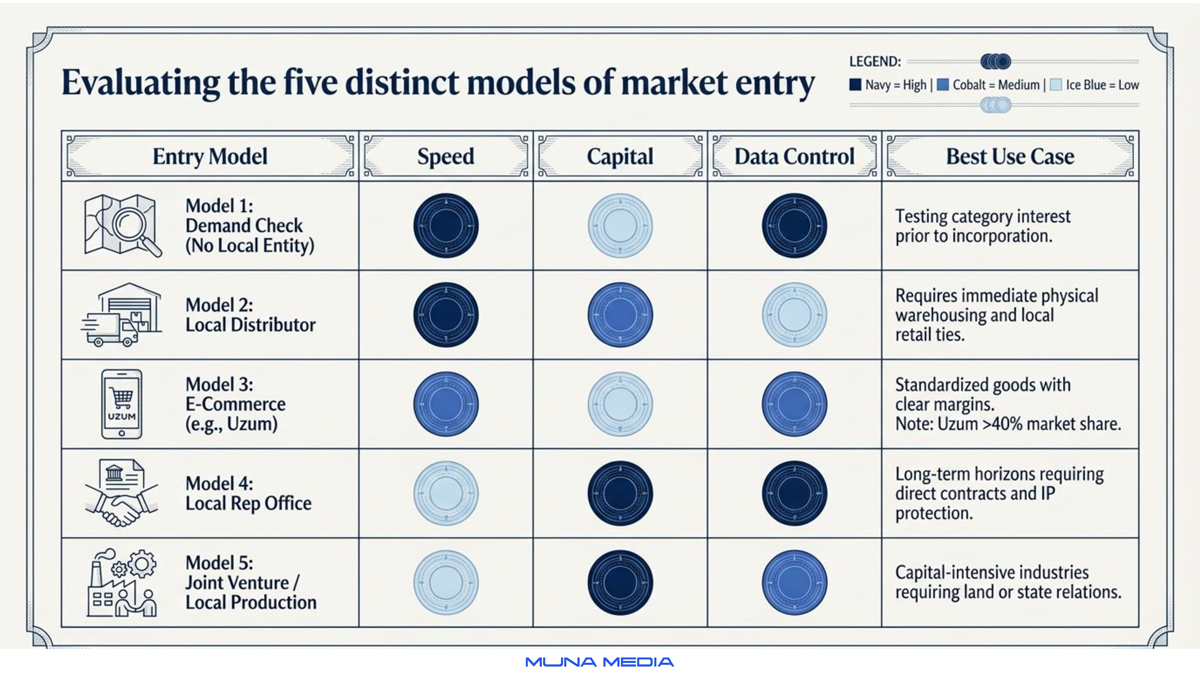
Five entry models
Model 1. Demand validation before establishing a local entity
Use this when you need to understand category demand before opening an office.
A responsible validation can include:
15 to 25 interviews with buyers, partners, and category operators;
analysis of search behaviour and local communities;
a localized information or waiting-list page with honest availability terms;
tests of three offer and price variations;
a limited campaign in one city;
measurement of qualified conversations rather than clicks alone.
The main risk is collecting demand you cannot serve. Every test should make timing, geography, and fulfilment conditions clear.
Model 2. Distribution through a local partner
This can work when import, warehousing, trade relationships, and service matter.
The benefit is speed through an existing network. The risk is losing direct customer knowledge and becoming dependent on the partner's execution quality.
Before signing, verify:
actual geographic and channel coverage;
sales of comparable products;
access to customer and campaign data;
approval rules for communication;
the people who will execute, not only the relationship owners;
termination and handover terms;
ownership of local pages, phone numbers, ad accounts, and creative files.
Model 3. Selling through online marketplaces
This can be effective for standardized products with clear delivery economics and sufficient margin.
Uzum Market was officially recognized as a digital platform operator with a dominant position and a market share above 40% in its segment.[11] However, listing on a large marketplace does not remove the need to create demand. Product content, reviews, stock, delivery, price, instalment options, and promotion must function as one system.
Check:
seller and import requirements;
marketplace fees, storage, and fulfilment;
returns and warranty obligations;
internal promotion options;
settlement periods;
the impact of instalments on unit economics;
whether customer data can support repeat relationships.
Model 4. A local office or subsidiary
This is appropriate when the company needs its own team, long-term contracts, direct control, and sustained local operations.
Before incorporation, verify the legal form, tax treatment, employment, currency flows, trademark protection, and sector permits. A media agency can support market understanding and communication, but it does not replace legal, tax, customs, or regulatory counsel.
Model 5. A joint venture or local production
This is relevant for capital-intensive businesses that depend on incentives, manufacturing infrastructure, or local institutional relationships.
Communication comes after more fundamental checks: partner governance, land, permits, supply, skills, capital protection, and dispute resolution.
Language is part of the product
What language must advertising use in Uzbekistan?
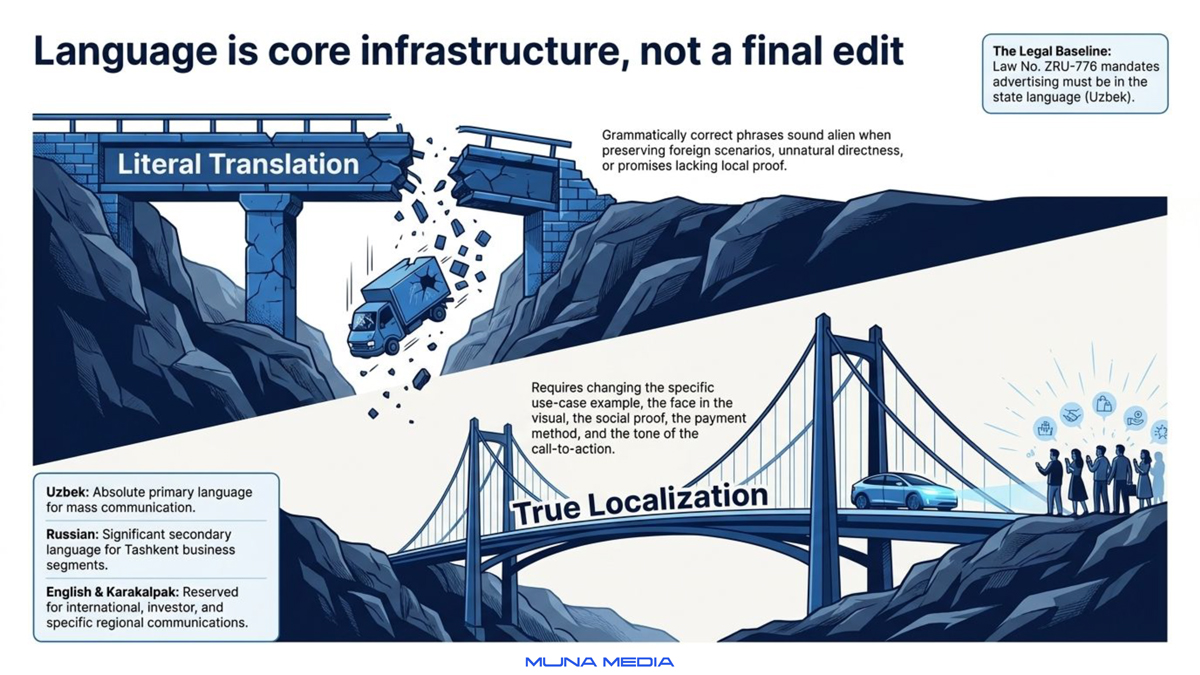
Uzbekistan's Law on Advertising No. LRU-776 requires advertising to be disseminated in the state language, Uzbek. Other-language versions may accompany it subject to the law's requirements.[5]
In practice, a language system should account for:
Uzbek as the main language for mass-market communication;
Russian as an important second language for parts of the audience, particularly in Tashkent and some professional segments;
English for international, investment, and selected business audiences;
Karakalpak for relevant work in Karakalpakstan;
differences between Uzbek Latin script, conversational language, and formal government or legal wording.
Why literal translation underperforms
A sentence can be grammatically correct and still feel foreign. This happens when a translation preserves:
the source market's argument order;
an unfamiliar level of directness;
humour without local context;
a claim that lacks local proof;
a usage situation that does not exist locally;
an inappropriate form of address.
Localization should adapt the example, proof, talent, setting, payment method, and next step, not only the words.
A practical language architecture
For a mass-market launch:
Uzbek: primary campaign and landing-page version;
Russian: additional version for relevant segments;
English: page for partners, press, investors, and regional leadership;
one approved glossary for product names, functions, guarantees, and legal terms;
native-language editorial review before publication.
The Uzbekistan media landscape
Internet and mobile behaviour
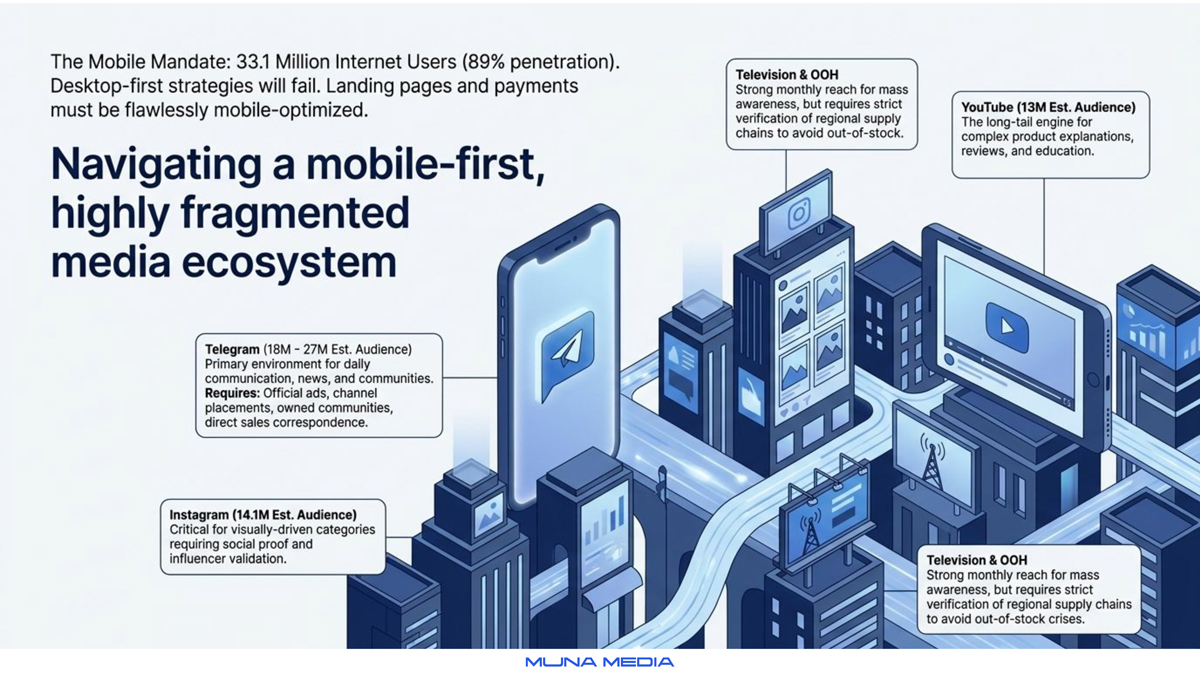
DataReportal estimated 33.1 million internet users, or about 89% penetration, by the end of 2025.[4] An official Statistics Committee indicator was higher. Do not combine these numbers without qualification because the sources may use different populations, timeframes, and definitions.
The practical implication is clear: the landing page, form, payment, and customer support must work seamlessly on a phone. Mobile cannot be treated as a smaller desktop page with tiny text and heavy assets.
Telegram
Telegram is a major environment for everyday communication, news, and communities. Industry estimates range roughly from 18 to 27 million users, but there is no single transparent public measurement that makes one figure official.
A market-entry plan should distinguish four different uses:
Telegram's official advertising platform;
sponsored posts in channels;
an owned channel or community;
sales and customer support through messaging.
These do different jobs. A large channel placement does not replace customer response, and an official ad account does not automatically create trust.
Instagram
DataReportal estimated Instagram's advertising audience at about 14.1 million.[4] It is particularly relevant for categories where visual demonstration, creators, social proof, and product presentation affect choice.
Before selecting a creator, review:
the share of genuinely local followers;
comment quality, not just follower count;
age and city fit;
previous commercial content;
abnormal audience growth;
rights to reuse the content;
the method for connecting activity to enquiries and sales.
YouTube
YouTube supports long-lived educational and comparison content. The source research placed monthly reach around 13 million. Monetization availability has changed over time and should be rechecked before making commercial claims.
For a brand, the relevant questions are whether the right channels exist, whether people watch the content meaningfully, and whether video connects to search, product pages, and purchase.
Television
Kantar industry measurement indicates that television continues to deliver high monthly reach. It can be effective for rapid mass awareness, but it requires meaningful budget, frequency, and product availability.
Do not choose television simply because it is broad. First ask:
is the product available in the covered regions?
can the supply chain withstand demand?
can the value proposition be understood in 10 to 20 seconds?
how will changes in branded search, store visits, and sales be measured?
can cities or periods be compared?
Outdoor and digital outdoor media
Tashkent is the centre of Uzbekistan's outdoor market. Digital screens are expanding, while prime placements can sell out early. Industry estimates for structure count, reach, and spending should be treated as directional, not as one official market dataset.
A government service exists for obtaining an advertising-place passport on private property.[6] Sites and creative must meet current rules and city design requirements.
Verify more than a sales photograph:
exact coordinates;
direction of travel;
viewing time and distance;
obstructions;
screen uptime;
loop length and share of voice;
site documentation;
time-stamped proof of placement;
the reach method and its limitations.
Creators and influencers
There is no standardized public rate card. Pricing varies by category, format, usage rights, urgency, and creator reputation. Follower count alone is a weak decision metric.
Select partners by:
audience fit;
trust in the relevant category;
history of commercial work;
interaction quality;
operational discipline around timing, revision, disclosure, reporting, and usage rights.
A system, not a platform list
The role of each channel
Choose channels by the customer's task. One platform rarely carries a person from first exposure to purchase.
Channel
Primary role
Strength
Limitation
Measure
Television
Awareness
Fast mass reach
Requires budget, frequency, and stock
Awareness, branded search, regional sales
Outdoor
Presence
Urban visibility and repetition
Quality depends on the specific site
Proof, reach, search, store visits
Telegram
Trust and action
News, communities, and messaging
Channel audiences are unevenly measured
Visits, questions, qualified enquiries
Instagram
Demonstration
Visual proof and creators
Followers are not automatically local buyers
Audience quality, saves, sales
YouTube
Explanation
Reviews, comparison, long shelf life
Production and measurement take time
Retention, visits, search, enquiries
Search
Existing demand
The user is already looking
Does not create mass awareness alone
Qualified enquiries, sales, profit
Marketplaces
Purchase
Payment and fulfilment environment
Fees, competition, limited data access
Orders, returns, repeat purchases
How to choose a media mix
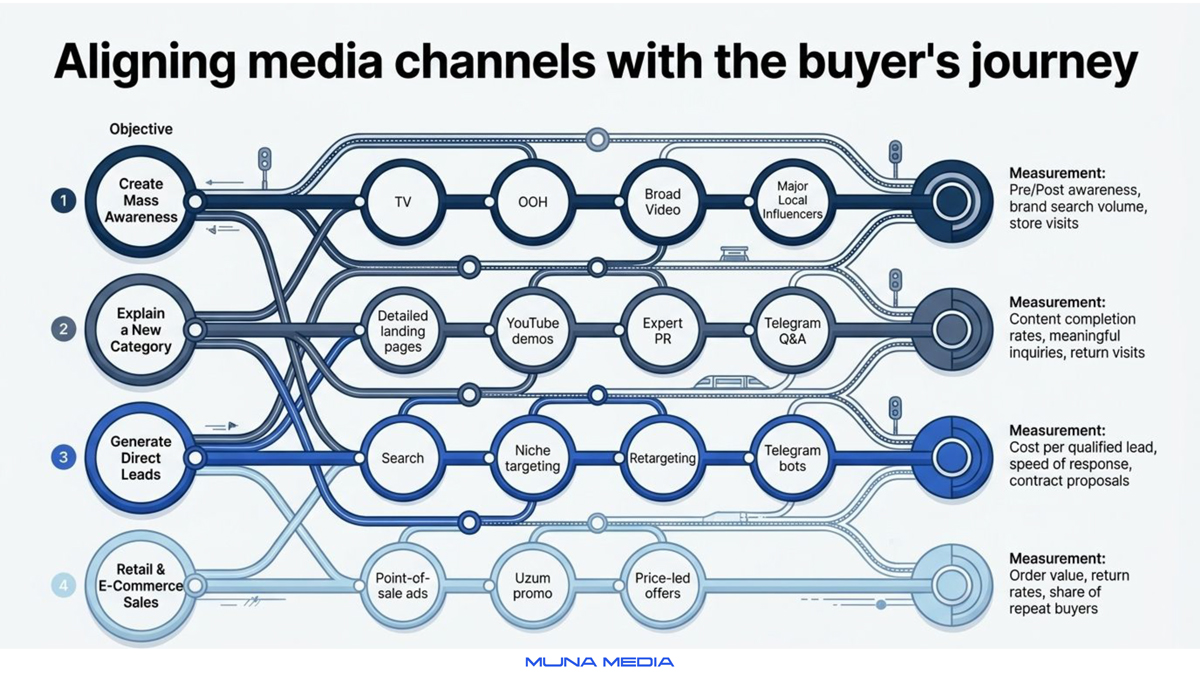
Start with the customer journey, not the cheapest placement.
Objective: create awareness
Potential roles:
→ television;
→ outdoor media;
→ large local creators;
→ broad video distribution;
→ meaningful links to local events and communities.
Measure:
→ awareness before and after;
→ growth in branded search;
→ direct visits;
→ reach and frequency;
→ sales where the product is available.
Objective: explain a new offer
Potential roles:
→ a detailed landing page;
→ search-oriented articles;
→ demonstration video;
→ expert media coverage;
→ trusted category creators;
→ responsive Telegram and messaging support.
Measure:
→ completion of key content sections;
→ audience questions;
→ visits to pricing and terms;
→ qualified enquiries;
→ repeat visits.
Objective: generate qualified enquiries
Potential roles:
→ search;
→ tightly targeted paid media;
→ retargeting;
→ specialist channels;
→ offer-specific landing pages;
→ forms, calls, and messaging with a defined response time.
Measure:
→ cost per qualified enquiry;
→ qualification rate;
→ response speed;
→ meetings;
→ proposals and contracts;
→ revenue, not form submissions alone.
Objective: drive retail or marketplace sales
Potential roles:
→ media near points of sale;
→ marketplace product content and internal promotion;
→ local creators;
→ transparent price-led offers;
→ local payment and instalment options;
→ retargeting.
Measure:
→ stock availability;
→ city-level sales;
→ cost per order;
→ returns;
→ new-customer share;
→ repeat purchase.
Online commerce and payments
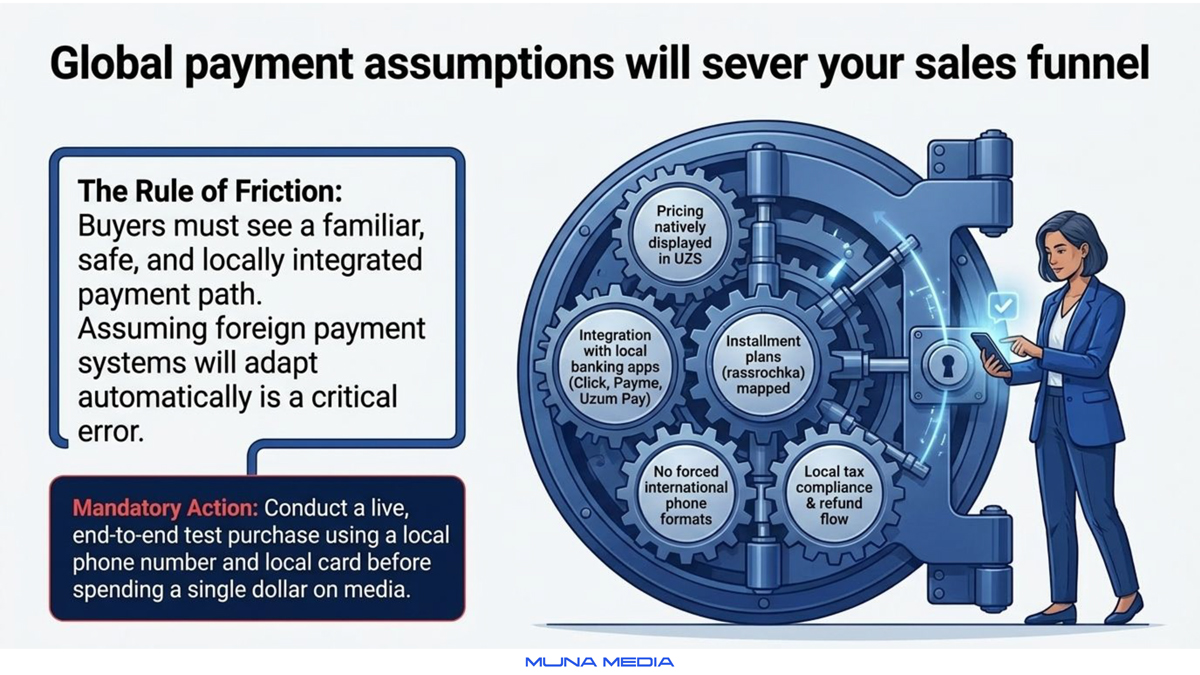
The purchase path must match local habits. Uzbekistan has widely used local payment applications and bank products. Cash on delivery and instalment plans remain important in selected categories.
Do not assume that an international payment service works as it does in your home market. Before spending on acquisition, complete a real test payment using a local phone and local card.
Operational checklist:
display the price in Uzbek soum;
show the full amount before payment;
support the target customer's preferred local methods;
avoid forms that require a foreign phone number;
send confirmation in the expected language;
explain returns before purchase;
operate customer support in local business hours;
document sales according to local tax requirements;
confirm that the product is actually available in the promised city.
Regulatory and operational requirements
This guide is not legal advice. Check the current law and sector-specific requirements before launch.
Minimum launch checklist
advertising is prepared in Uzbek;
additional language versions do not distort the primary meaning;
names, prices, conditions, and limitations are accurate;
image, music, talent, and content rights are documented;
special rules for finance, medicine, alcohol, tobacco, and other regulated sectors are reviewed separately;
outdoor sites have the required documentation;
personal-data handling is reviewed;
creator agreements define disclosure, timing, revisions, reporting, and usage rights;
tax treatment for non-resident media platforms is reviewed locally;
the landing page does not promise what supply and customer support cannot deliver.
Why local legal review matters
A regional contract may not address:
state-language requirements;
local permits;
non-resident transactions;
tax and documentation;
trademark protection;
sector restrictions;
dispute-resolution realities.
Local legal review is not an administrative delay. It prevents a campaign from being stopped after the budget is already committed.
How to validate demand before major investment
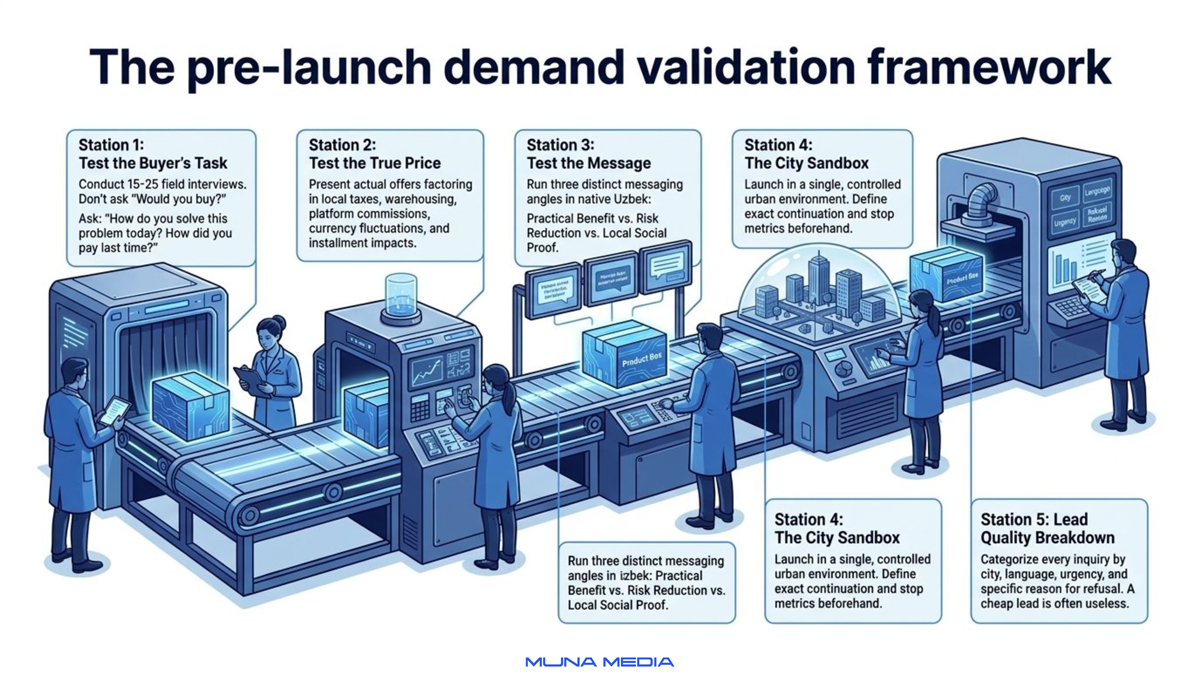
Step 1. Validate the customer problem
Interview at least three groups:
→ potential buyers;
→ people who influence the decision;
→ category sellers, distributors, or specialists.
Avoid asking, “Would you buy this?” Ask:
→ how the problem is solved today;
→ what is unsatisfactory;
→ when a comparable purchase last happened;
→ who participated in the decision;
→ which alternatives were considered;
→ why one was chosen or rejected;
→ where information came from;
→ how payment and fulfilment worked.
Step 2. Test price and commercial conditions
Show real offer variations rather than asking about abstract willingness to pay. Local price must include:
→ import and tax;
→ warehousing and delivery;
→ distributor or marketplace fees;
→ service and returns;
→ media;
→ currency movement;
→ instalment economics;
→ a reserve for first-period errors.
Step 3. Test messages
Develop at least three directions:
→ practical value;
→ risk reduction;
→ social proof or a relevant local example.
Each should exist in Uzbek and lead to one measurable action.
Step 4. Run a city-level pilot
Start with one city or comparable districts. Define in advance:
→ the target group;
→ the offer;
→ where the product is available;
→ the continuation threshold;
→ the stop threshold;
→ the specific uncertainty the pilot should resolve.
Step 5. Review enquiry quality
A cheap lead can still be worthless. Record:
→ city;
→ language;
→ need;
→ decision timeframe;
→ expected volume;
→ source;
→ rejection reason;
→ next action.
A planning model for the first launch budget
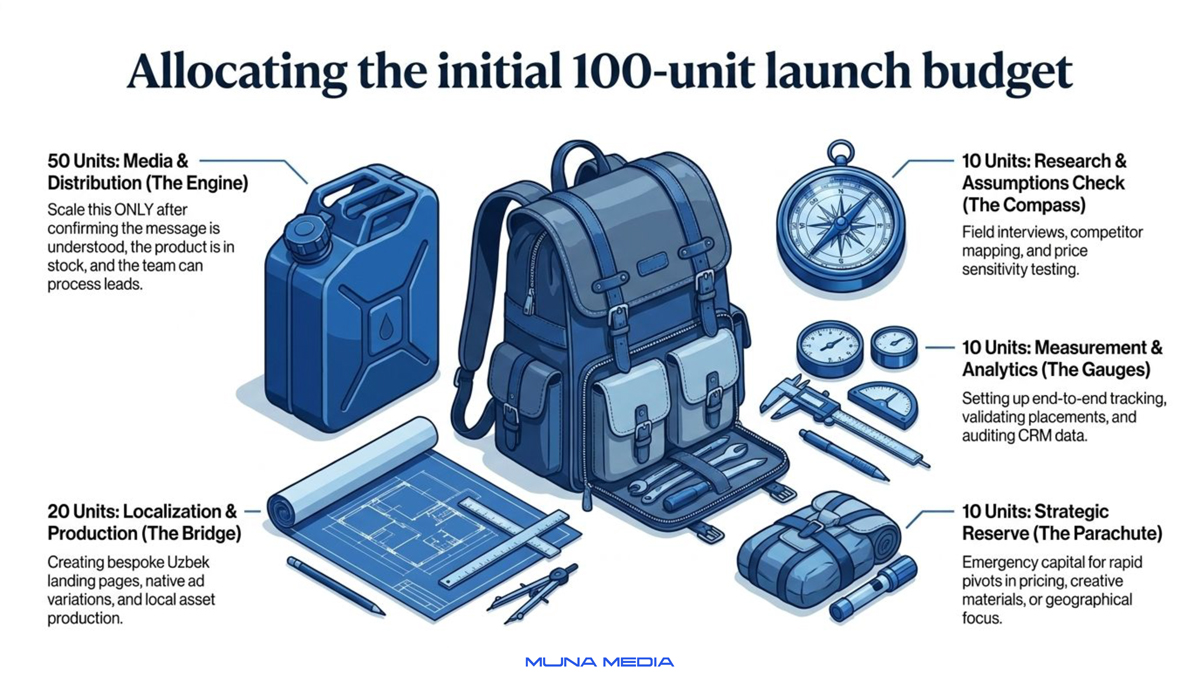
The following is not a local market rate. It is a planning example for every 100 budget units:
10 units: research and assumption testing;
20 units: localization, creative production, and landing pages;
50 units: media and distribution;
10 units: measurement, placement verification, and analysis;
10 units: reserve for changes in price, creative, channel, or geography.
Increase the media share only after proving that:
the message is understood;
mobile pages work;
enquiries are answered quickly;
the product is available;
outcomes can be connected to their source.
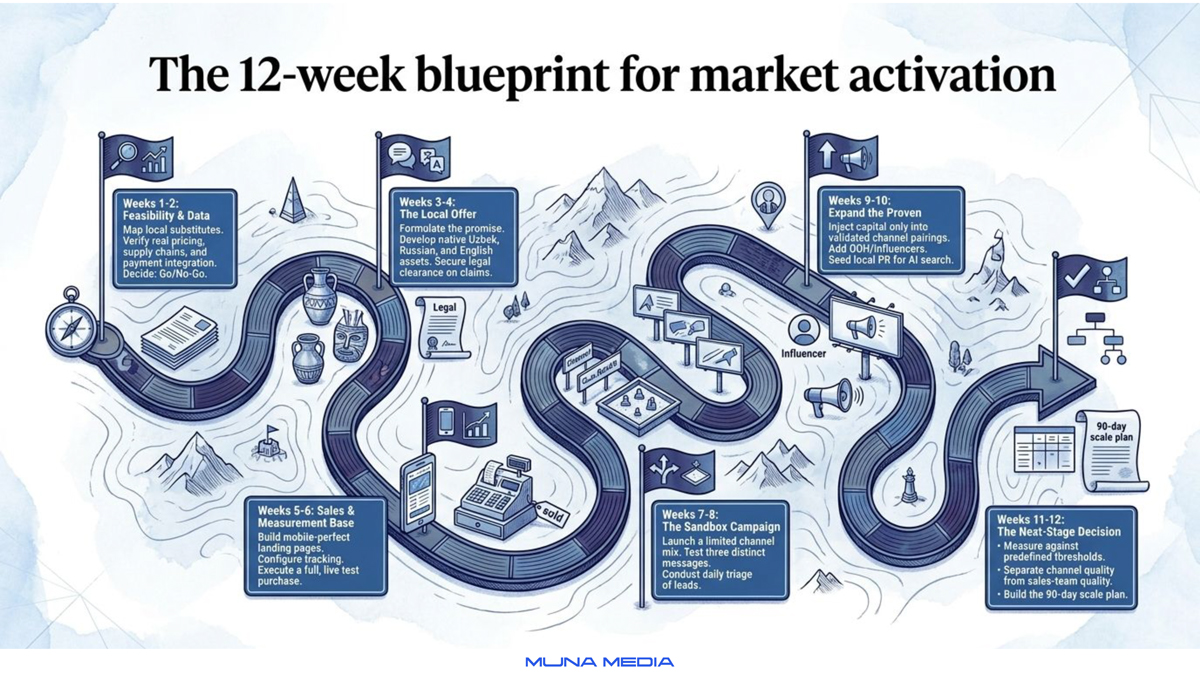
A 12-week market-entry launch plan
Weeks 1-2. Go or no-go assessment
→ define the category and first city;
→ separate official from industry data;
→ conduct interviews;
→ map competitors and substitutes;
→ test price, fulfilment, and payment;
→ decide whether to continue, change, or stop.
Weeks 3-4. Local proposition
→ select the segment;
→ define the promise;
→ prepare Uzbek, Russian, and English versions as required;
→ review legal wording;
→ develop local examples and evidence;
→ approve one product glossary.
Weeks 5-6. Sales and measurement foundation
→ build the landing page;
→ configure forms, calls, and messaging;
→ test payment;
→ implement measurement events;
→ create a qualified-enquiry dashboard;
→ run a complete test purchase.
Weeks 7-8. Controlled pilot
→ launch a limited channel set;
→ test three message directions;
→ monitor frequency and placement quality;
→ review enquiries daily;
→ improve the page, response, and offer.
Weeks 9-10. Expand what has evidence
→ increase spending only in working combinations;
→ add creators, outdoor, or video when the role is proven;
→ publish content for search and AI-generated answers;
→ strengthen local references and reviews;
→ test a second city or segment.
Weeks 11-12. Scale decision
→ compare results with the pre-agreed threshold;
→ separate channel quality from sales handling;
→ document rejection reasons;
→ decide what to scale;
→ prepare the next 90-day plan;
→ stop activity that produces attractive dashboards without commercial value.
From decision to scale
A 12-week launch plan
This timeline fits demand validation and a controlled campaign. Incorporation, import, and sector permits may take longer.
1-2
Decision
Segment, city, interviews, competitors, price, fulfilment, and stop criteria.
3-4
Local proposition
Promise, Uzbek version, proof, legal review, and approved terminology.
5-6
Sales foundation
Landing page, form, payment, support, measurement events, and test purchase.
7-8
Controlled pilot
Limited channels, three messages, and daily review of enquiry quality.
9-10
Expand the proven
Scale working combinations, test a second segment, and build local proof.
11-12
Scale decision
Results against threshold, rejection reasons, and the next 90-day plan.
Muna Media rule: do not scale media buying until stock, payment, response speed, and enquiry quality are proven.
How to measure a launch
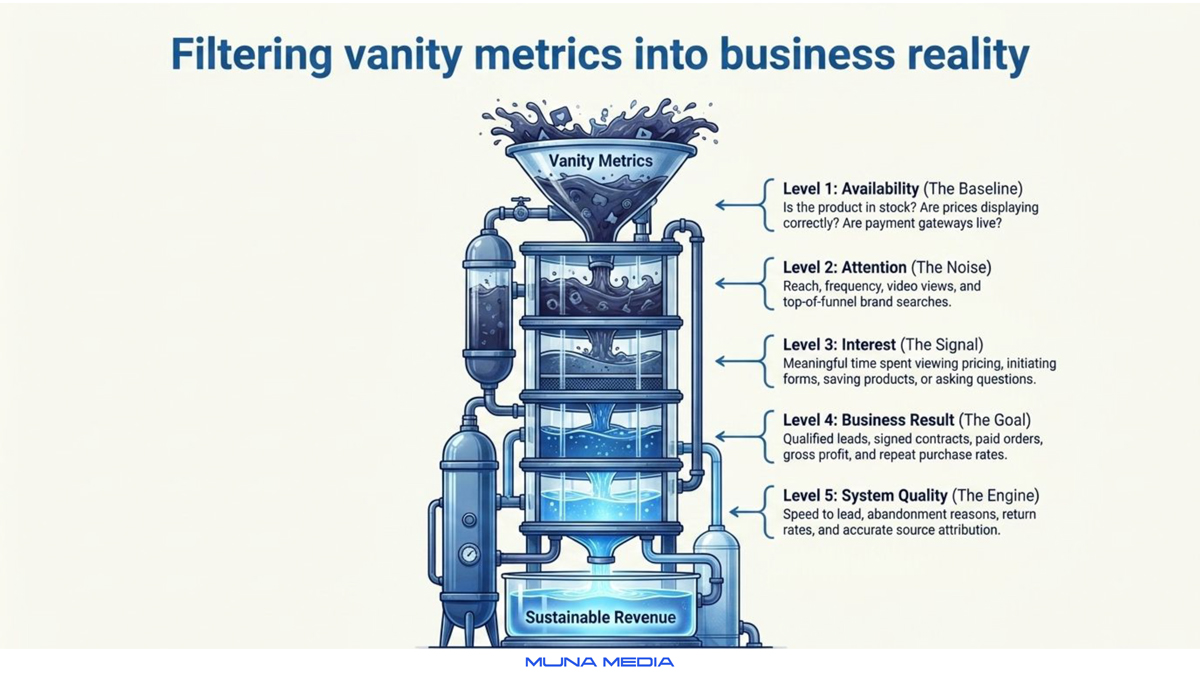
Level 1. Availability
→ product is in stock;
→ price displays correctly;
→ payment works;
→ forms submit;
→ support responds;
→ paid placements are actually live.
Level 2. Attention
→ reach;
→ frequency;
→ video viewing;
→ site visits;
→ growth in branded search;
→ direct traffic.
Level 3. Consideration
→ viewing pricing and terms;
→ product selection;
→ form starts;
→ qualified questions;
→ repeat visits;
→ saves and shares.
Level 4. Business outcomes
→ qualified enquiry;
→ meeting;
→ proposal;
→ contract;
→ paid order;
→ revenue and gross profit;
→ repeat purchase.
Level 5. System quality
→ response time;
→ unanswered enquiry rate;
→ rejection reasons;
→ stock availability;
→ returns;
→ city and language differences;
→ share of sales with a traceable source.
A visit to the booking page is not a booking. A submitted form is not a sale. Each stage needs its own event and definition.
Visibility in AI-generated answers
What has changed
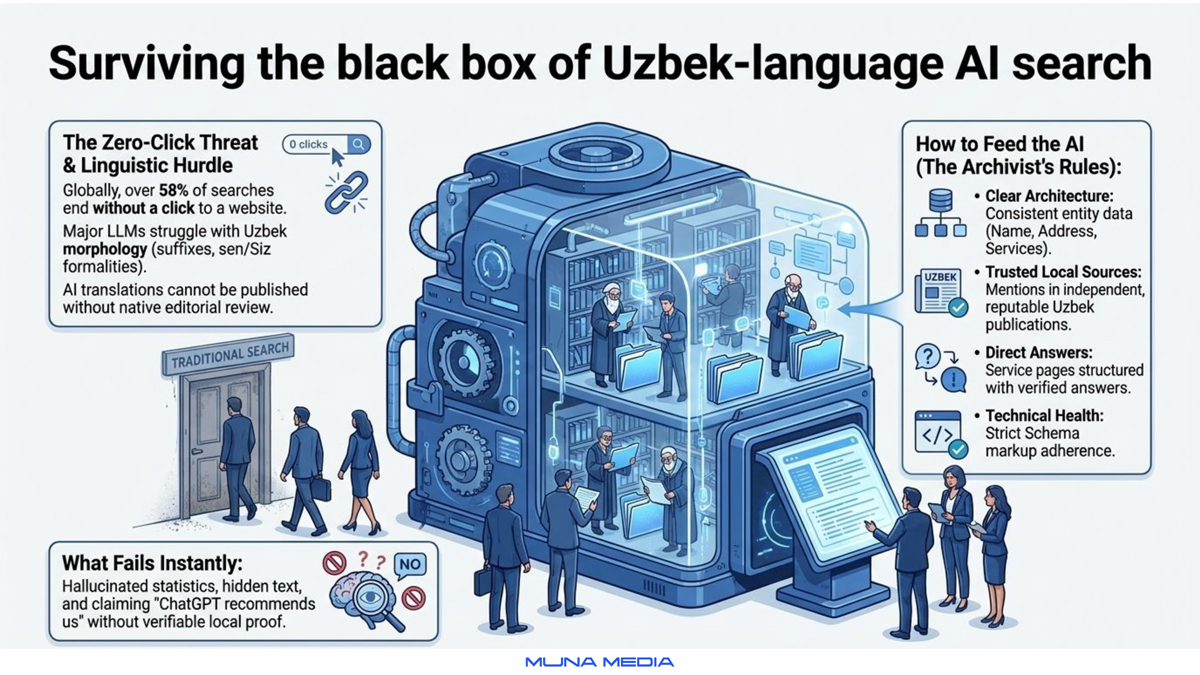
Search increasingly ends without a click to an external website. SparkToro and Datos reported that 58.5% of Google searches in the United States and 59.7% in the European Union ended without an open-web click in 2024.[10] Other panels and later periods produce different numbers. These are global benchmarks, not Uzbekistan-specific measurements.
Pew Research Center found that users were less likely to click traditional results when an AI summary appeared, while links inside the summary received a click in only about 1% of visits.[8] Ahrefs estimated that the first organic result lost about 58% of its clicks when an AI Overview was present.[9]
The implication is that a company should measure not only ranking, but also how AI systems describe the company, the topics they associate it with, and the sources they cite.
Why Uzbekistan needs a local approach
A 2025 study documented systematic grammatical errors when major language models generated Uzbek. More than one-third of the identified issues were morphological, including suffix order, agreement, and forms of address such as sen/Siz.[7]
This means:
AI-generated Uzbek should not be published without native editorial review;
the same buyer question should be tested in Uzbek, Russian, and English;
reliable local sources carry particular importance;
early publishers of clear, sourced, structured Uzbek material can build a meaningful information advantage.
What helps AI systems understand a company
No single formula exists. Systems use different search indexes, retrieval methods, and policies. Useful foundations usually include:
one unambiguous company name;
consistent details across the site, directories, and media coverage;
service pages that answer buyer questions directly;
named authors, dates, and visible update history;
citations to primary sources;
clear tables, definitions, and methodologies;
independent local and industry mentions;
real reviews and local-presence details;
crawlable, indexable pages;
relevant Article, Organization, Service, and BreadcrumbList structured data.
What does not work
hundreds of near-duplicate city pages;
invented statistics;
hidden text;
repetitive keyword stuffing;
fake reviews and ratings;
claims that “ChatGPT recommends us” without evidence;
machine translation without local review;
expecting technical markup to replace reputation.
A 90-day AI visibility plan
Days 1-15. Question map and baseline
collect 50 to 100 real buyer questions;
test them in three languages;
save the exact prompt, date, system, answer, and sources;
record omissions and inaccuracies;
select the 15 highest-value commercial questions.
Days 16-35. Entity foundation
standardize name, address, description, services, and leadership details;
update company and service pages;
add authors, dates, and sources;
correct language versions and their links;
implement structured data.
Days 36-60. Citable resources
publish direct answers to key questions;
create local tables, definitions, and checklists;
disclose methods and data limitations;
add real examples without fabricated outcomes;
obtain native editorial review for Uzbek.
Days 61-90. Independent validation and remeasurement
contribute expert comments to credible local media;
correct directories and profiles;
collect substantive customer reviews;
repeat the same question set;
measure presence, accuracy, sentiment, and cited sources;
connect changes to visits, enquiries, and revenue without treating correlation as proof of causation.
A credibility system, not a trick
How to become understandable to search and AI
No one can buy guaranteed citation. A company can create accurate information, accessible pages, and independent validation.
01
One entity
Consistent name, description, address, services, leadership, and language versions across sources.
02
Direct answers
Pages answer buyer questions early instead of hiding meaning behind campaign slogans.
03
Evidence
Named author, date, primary sources, methodology, real examples, and visible limitations.
04
Independent mentions
Credible local media, industry sources, directories, and substantive reviews.
05
Technical access
Indexable pages, connected language versions, structured data, and no conflicting duplicates.
06
Repeat measurement
One question set, three languages, answer accuracy, sentiment, and cited sources.
The main risks and how to control them
Risk: treating an industry estimate as a fact
What happens: the budget is built on one attractive audience number.
Control: use ranges, name the source, and validate against your own pilot.
Risk: translating without localizing
What happens: the text is understandable but does not build trust.
Control: adapt the example, proof, form of address, price, and next step with the language.
Risk: buying reach before the sales system is ready
What happens: communication works but stock is missing, the form fails, or no one responds.
Control: complete a full test purchase before launch.
Risk: outsourcing the entire market to one distributor
What happens: the company lacks data and learns about problems too late.
Control: define data access, reporting, and the right to conduct direct customer research.
Risk: measuring only media
What happens: a channel is blamed for a problem caused by price, availability, or response quality.
Control: measure the full path from impression to paid order.
Risk: treating AI answers as a free acquisition channel
What happens: the company expects rapid referral traffic that may never arrive.
Control: evaluate accuracy and share of presence alongside search, reputation, enquiries, and revenue.
Six common failure modes
Market-entry risk map
High
Media before fulfilment
Demand is created, but stock, payment, or support is missing.
Control: complete a full test purchase before launch.High
No Uzbek version
Trust suffers and legal exposure increases.
Control: Uzbek copy and native editorial review.High
One attractive audience number
The plan relies on an unverified estimate.
Control: ranges, named sources, and a city-level pilot.Medium
One distributor owns the market
The company loses customer insight and data.
Control: data rights and regular joint reviews.Medium
Only clicks are measured
Channels are judged without enquiry quality or sales.
Control: events through payment and gross profit.Medium
Expecting instant AI visibility
Technical markup is mistaken for reputation.
Control: sources, local language, and independent mentions.
How to select a local partner
Ask for operational evidence, not only a polished presentation:
→ a sample media plan with assumptions;
→ an outdoor placement-verification process;
→ a channel and creator reporting example;
→ audience-selection and fraud-check rules;
→ the event map from visit to sale;
→ a weekly review format;
→ the Uzbek-language approval process;
→ work done in-house versus outsourced;
→ account and data-access rules;
→ the response to underperformance;
→ the handover process for files, pages, and accounts.
Questions to ask before signing
Which data is official and which is an industry estimate?
Who owns Uzbek copy quality and how is it reviewed?
How will live placement be verified?
Which measurement events will exist before launch?
How will enquiries connect to revenue?
Who owns accounts, data, and creative files?
How quickly can the team change weak messaging?
Which legal questions are explicitly outside the agency's scope?
What will the report to regional management look like?
What evidence would cause the campaign to stop?
Frequently asked questions
Should Uzbekistan be the first Central Asian market?
It can be when population scale, young consumers, and local adaptation matter. Kazakhstan may be equally suitable or preferable for higher-value categories and more mature online commerce. The category should determine the sequence, not population alone.
Is a Tashkent-only launch sufficient?
It is often sufficient for a first pilot. Tashkent results should not automatically be projected to the rest of the country. Income, availability, language, channels, and delivery need to be revalidated for each expansion area.
Is Uzbek necessary?
Yes. Uzbek matters both as a legal advertising requirement and as the foundation of mass-market trust. Russian and English may complement it, but should not replace it.
What is the strongest advertising channel?
There is no universal winner. Telegram matters for communication and communities, Instagram for visual categories and creators, television and outdoor for broad awareness, and search for existing demand. The mix should follow the customer journey.
Can Telegram audience figures be trusted?
They should be treated as industry ranges, not one official population number. Decisions should be validated through specific channels, placements, and commercial outcomes.
Is a local distributor required?
Not always. Distribution partners are useful when import, warehousing, trade relationships, and service are critical. The agreement should preserve access to data and customer understanding.
Can demand be tested before incorporation?
In many categories, research, interviews, a localized page, and a limited campaign can be run first. Payments, import, employment, and contracts need separate legal review.
Which payments should a company support?
The methods the chosen customer actually uses. Run a real payment test using a local card and phone, including confirmation, refund, and support.
How long does market-entry preparation take?
A demand-validation and pilot program can often be organized in 8 to 12 weeks when the product is ready and legal questions are resolved quickly. Incorporation, import, sector licensing, and production can extend the timeline substantially.
When is a launch ready to scale?
When the company can repeat an acceptable result: understood messaging, available product, working payments, viable qualified-enquiry or order economics, and an operating team that can absorb more demand.
Can a company guarantee inclusion in AI-generated answers?
No. A company can improve information quality, publish citable material, and strengthen independent validation. The system decides what to retrieve and cite.
How should AI visibility be measured?
Use a stable set of questions. Record language, system, date, company presence, accuracy, sentiment, and cited sources. Compare monthly and connect changes to visits and enquiries cautiously.
The practical conclusion
Uzbekistan offers international companies a rare combination of population scale, young consumers, and rising demand. Capturing the opportunity requires discipline:
separate official facts from industry estimates;
treat language as part of the product;
align media with product availability;
do not treat Tashkent as the entire country;
give every channel a role in the customer journey;
review legal and tax questions locally;
measure through to revenue, not only clicks;
build search and AI visibility on accurate local-language information and independent evidence.
Muna Media helps international and regional companies research the market, localize the proposition, select an integrated channel mix, manage production and placement, and connect media activity to business outcomes.
This guide was developed from a Muna Media research report dated 30 July 2026. Official indicators are separated from industry estimates. Uzbekistan does not have one transparent, unified public measurement system covering all digital and outdoor advertising. Recheck law, platform availability, and market data before making legal or budget decisions.