


































By clicking, you agree to our privacy policy.


from __future__ import annotations
import json
import re
from pathlib import Path
BASE = Path(__file__).resolve().parents[1]
ARTICLES = BASE / "articles"
SCHEMA = BASE / "schema"
SCHEMA.mkdir(exist_ok=True)
PAIRS = [
{
"lang": "ru",
"article": ARTICLES / "H02-RU-izmerenie-kampanii-do-zapuska.md",
"output": SCHEMA / "H02-RU-izmerenie-kampanii-do-zapuska.json",
"url": "https://www.munamedia.me/club/otsenka-reklamy/izmerenie-kampanii-do-zapuska",
"headline": "Как спроектировать измерение рекламной кампании в Узбекистане до запуска",
"description": "Как настроить измерение рекламы до запуска: карта событий, данные сайта и CRM, владельцы, проверка аналитики и Measurement Blueprint.",
"category_name": "Оценка рекламы",
"category_url": "https://www.munamedia.me/club/otsenka-reklamy",
"blog_name": "Блог",
"author": "Команда Muna Media",
"topics": ["Измерение рекламной кампании", "Узбекистан"],
},
{
"lang": "en",
"article": ARTICLES / "H02-EN-campaign-measurement-uzbekistan-before-launch.md",
"output": SCHEMA / "H02-EN-campaign-measurement-uzbekistan-before-launch.json",
"url": "https://www.munamedia.me/en/club/marketing-measurement/campaign-measurement-uzbekistan-before-launch",
"headline": "How to Design Campaign Measurement in Uzbekistan Before Launch",
"description": "Design campaign measurement before launch: map events, connect website and CRM data, assign owners, test analytics and use a practical blueprint.",
"category_name": "Marketing Measurement",
"category_url": "https://www.munamedia.me/en/club/marketing-measurement",
"blog_name": "Blog",
"author": "Muna Media Team",
"topics": ["Campaign measurement", "Uzbekistan"],
},
]
def clean(text: str) -> str:
text = re.sub(r"\[([^\]]+)\]\([^\)]+\)", r"\1", text)
text = text.replace("**", "").replace("`", "")
return re.sub(r"\s+", " ", text).strip()
def faqs(text: str) -> list[dict]:
block = re.search(r"^## FAQ\n(.*?)(?=^## Sources and evidence notes)", text, re.M | re.S)
if not block:
raise ValueError("FAQ block missing")
items = re.findall(r"^### (.+?)\n\n(.*?)(?=^### |\Z)", block.group(1), re.M | re.S)
return [
{
"@type": "Question",
"name": clean(question),
"acceptedAnswer": {"@type": "Answer", "text": clean(answer)},
}
for question, answer in items
]
def build(pair: dict) -> dict:
url = pair["url"]
text = pair["article"].read_text(encoding="utf-8")
return {
"@context": "https://schema.org",
"@graph": [
{
"@type": "BlogPosting",
"@id": f"{url}#article",
"mainEntityOfPage": {"@type": "WebPage", "@id": url},
"headline": pair["headline"],
"description": pair["description"],
"inLanguage": pair["lang"],
"author": {
"@type": "Organization",
"name": pair["author"],
"url": "https://www.munamedia.me/",
},
"publisher": {"@id": "https://www.munamedia.me/#organization"},
"about": [
{"@type": "Thing", "name": pair["topics"][0]},
{"@type": "Place", "name": pair["topics"][1]},
],
},
{
"@type": "BreadcrumbList",
"@id": f"{url}#breadcrumb",
"itemListElement": [
{"@type": "ListItem", "position": 1, "name": "Muna Media", "item": "https://www.munamedia.me/"},
{"@type": "ListItem", "position": 2, "name": pair["blog_name"], "item": "https://www.munamedia.me/en/club" if pair["lang"] == "en" else "https://www.munamedia.me/club"},
{"@type": "ListItem", "position": 3, "name": pair["category_name"], "item": pair["category_url"]},
{"@type": "ListItem", "position": 4, "name": pair["headline"], "item": url},
],
},
{
"@type": "FAQPage",
"@id": f"{url}#faq",
"mainEntity": faqs(text),
},
],
}
How to Design Campaign Measurement in Uzbekistan Before Launch
Short answer.
Campaign measurement must be designed before media is purchased. The team should define the business decision, target action, intermediate events, data sources, owners, review period and acceptable evidence level. It should then test the complete path from the advertising link to the CRM or sale. Only then should media go live and results be assessed against agreed rules.
A post-campaign report cannot recover missing data
An advertising report can organise what the system collected. It cannot recover the original source if tracking disappeared. It cannot determine lead quality if sales never updated CRM stages. It cannot connect an in-store purchase to a campaign if the team did not choose an identifier. It cannot prove causal impact merely because reach and sales increased during the same period.

Measurement therefore starts with neither a dashboard nor a list of platform metrics. It starts with the business decision the campaign must support.
A decision-maker may need to answer one of these questions:
- Should the team continue testing the selected message?
- Which audience progresses to a qualified enquiry?
- Is a Tashkent pilot ready to expand?
- Must the landing page be fixed before more budget is committed?
- Can a working combination be extended to new regions or channels?
- What level of evidence is sufficient for the next investment decision?
If the team cannot state the decision that follows the result, it will probably collect too many metrics and too little evidence.
Start with the decision, not the advertising metric
Saying that the business needs clicks, leads and sales does not yet describe a measurement system. These signals sit at different stages of the customer journey and answer different questions.
A click records a visit. A form submission records an on-site action. A qualified lead records a sales judgement. A paid order records a commercial outcome. No single signal explains the entire contribution of advertising.
Before launch, write down:
- the decision that must be made;
- the result that would count as a useful signal;
- the customer action representing that result;
- the system in which that action is recorded;
- the person responsible for validating data quality;
- the response to a strong, weak or contradictory result.
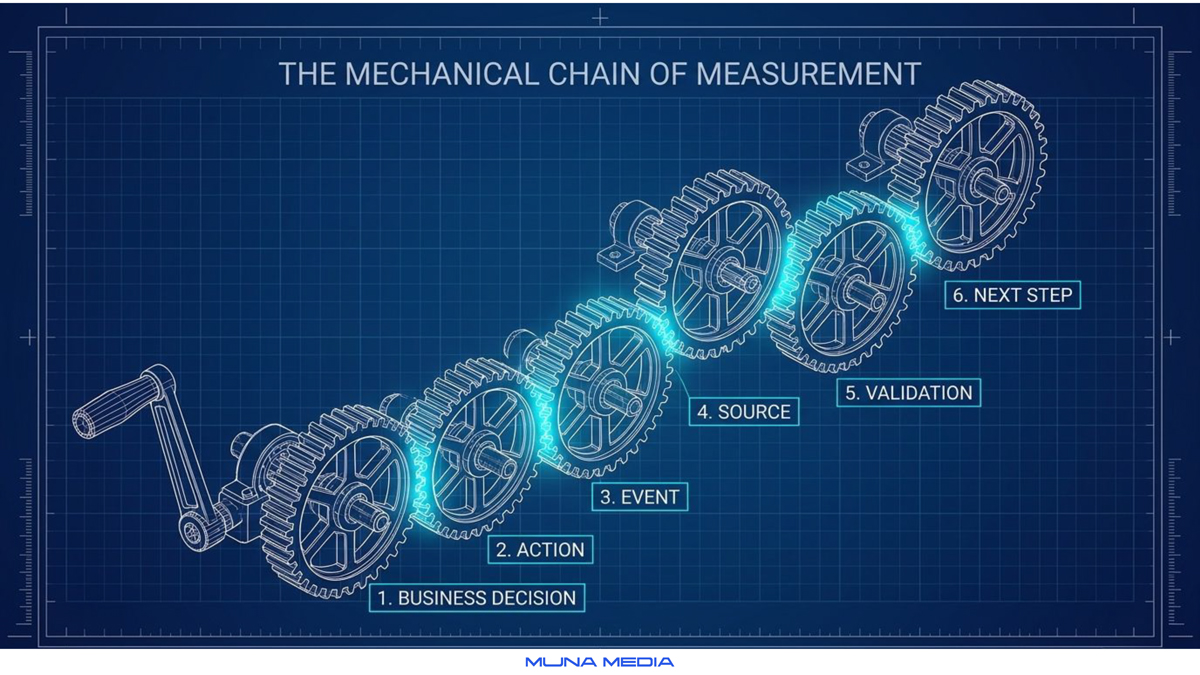
This turns a metric into part of an operating decision rather than a decorative reporting number. Together, these agreements form the campaign measurement contract: what the team observes, who validates the data and which decision follows.
Map events across the complete customer journey
An analytics event should correspond to a real interaction. Google Analytics defines an event as a way to measure a specific interaction or occurrence on a website or app. Some GA4 events are collected automatically, some have recommended names and parameters, and custom events can be defined when needed.
That is a technical foundation, not a complete measurement strategy. An event becomes useful when its role in the customer journey and its decision value are clear to the whole team.
Separate the journey into at least five levels:
- advertising contact;
- visit and engagement;
- target action;
- qualification;
- commercial outcome.
Define a distinct event at each relevant level. Do not use one generic conversion label for a page view, a form submission and a payment. These actions have different value and are validated in different systems.
In Google Analytics, any collected event can be marked as a key event when it represents an action that is particularly important to the business. The technical key-event setting does not replace a business definition. The team must still agree what counts as an enquiry, qualification, customer, return or cancellation. If the campaign captures enquiries, review demand quality separately. “The Cheapest Lead Can Become Your Most Expensive Customer” explains why CPL cannot be judged without qualification and commercial outcomes.
Connect media, website, CRM, calls and offline sales
An advertising platform sees only part of the journey. A website records page behaviour. A CRM holds the enquiry status. A contact centre hears the conversation. A point-of-sale or accounting system confirms payment. To prevent measurement from becoming five unrelated reports, the team needs a shared identifier and data-transfer rules before launch.
Depending on the project, the system may use:
- agreed UTM parameters;
- an advertising click identifier;
- an internal enquiry or order ID;
- a dedicated telephone number;
- a promotion code;
- a source field in the CRM;
- a store or regional marker;
- a confirmed campaign period;
- test and control geographies where the research design permits them.
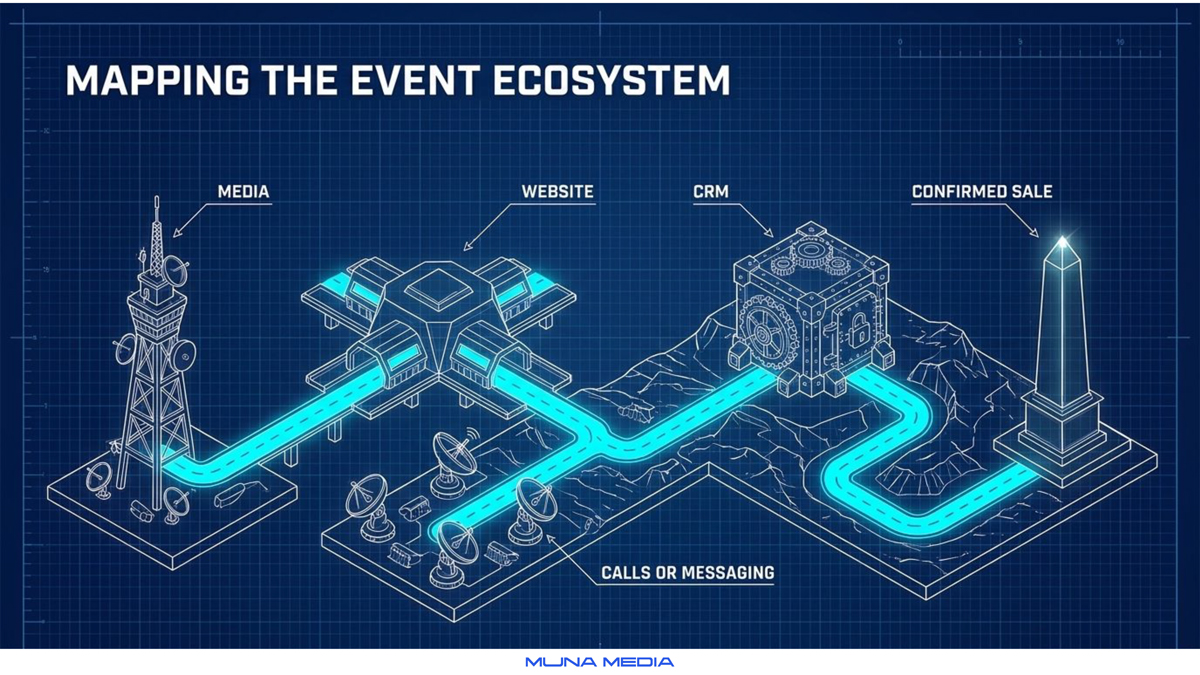
Not every campaign can connect every touchpoint at an individual level. Record that limitation before launch. Otherwise, the team may compare incompatible figures and label coincidence as attribution.
Google Ads supports offline conversion imports to send actions completed away from the website back into the advertising system. Enhanced conversions can supplement measurement with hashed first-party customer data when the platform requirements and applicable law are satisfied. Meta’s Conversions API can send website, app, business-messaging and offline events from a server, website platform, mobile app or CRM. When browser and server events are sent together, the implementation should prevent duplicates.
These tools increase observability. They do not remove the need for consent, access controls, data-protection measures or legal review of the specific implementation.
Assign an owner to every data source
Every metric needs both a source and an owner. Without ownership, marketing becomes accountable for a number created by another team, while sales may learn about a new lead definition after the campaign has started.
Responsibilities are usually distributed across several parties:
- headquarters defines the business decision and acceptable evidence level;
- the local team validates the market, language, customer path and operating constraints;
- the agency connects channels, events, timing and optimisation rules;
- developers or analysts implement and test events;
- sales maintains stages and reasons for rejection;
- finance or operations confirms commercial outcomes;
- a named measurement owner checks the consistency of the complete chain.
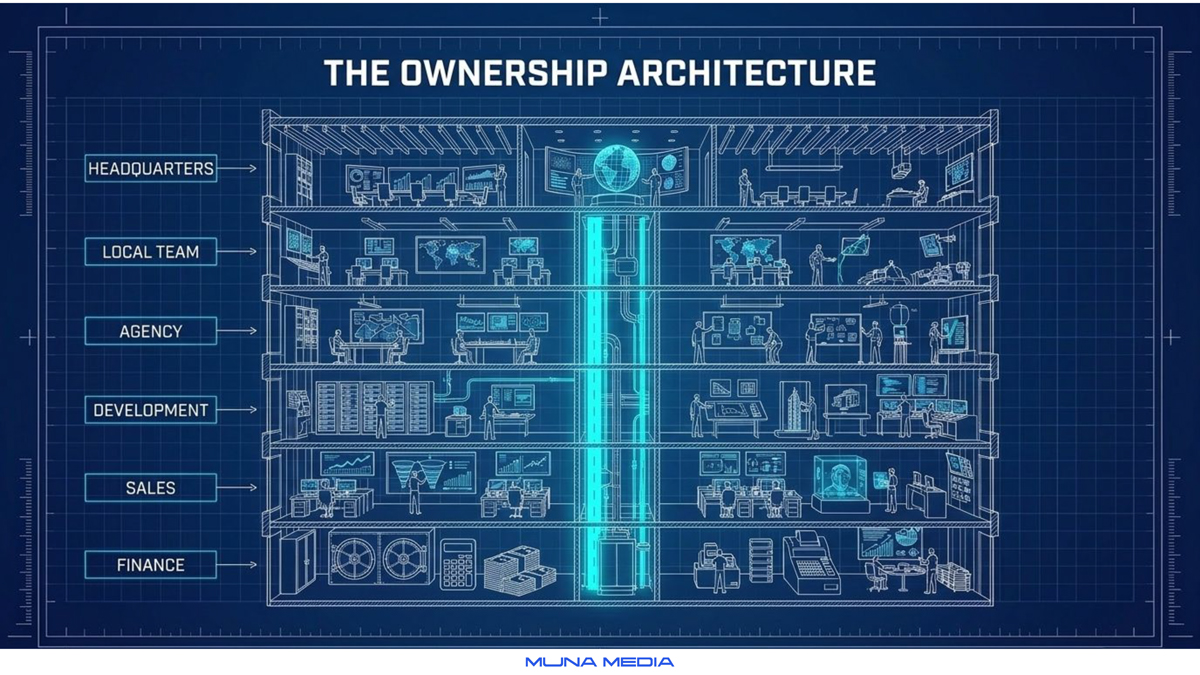
The responsibility matrix must exist before launch, not after the first disagreement between reports.
Test measurement before the first media purchase
Analytics readiness cannot be confirmed by a screenshot showing that a tag exists. The team must complete a test enquiry through the entire available path.
The test should include:
- a test advertising link with the correct parameters;
- the intended language and geographic version of the landing page;
- the agreed website or app events;
- a form submission, call or other target action;
- the enquiry appearing in the correct system;
- source and identifier retention;
- a sales-stage update;
- payment or another final outcome if it is within scope;
- access and visibility checks for responsible participants;
- checks for time zone, currency, geography and test-data exclusions.
If the full path cannot be completed, document the break and assign an owner. Then choose one of three statuses:
- Launch. Critical events, sources and owners have been validated.
- Launch as a limited pilot. The break is known, the pilot question is narrower and permitted conclusions are documented.
- Postpone launch. A critical break prevents the team from collecting the data required for the decision.
Incomplete measurement does not always prohibit a test. It prohibits a conclusion the system cannot support.
Measurement considerations for an Uzbekistan launch
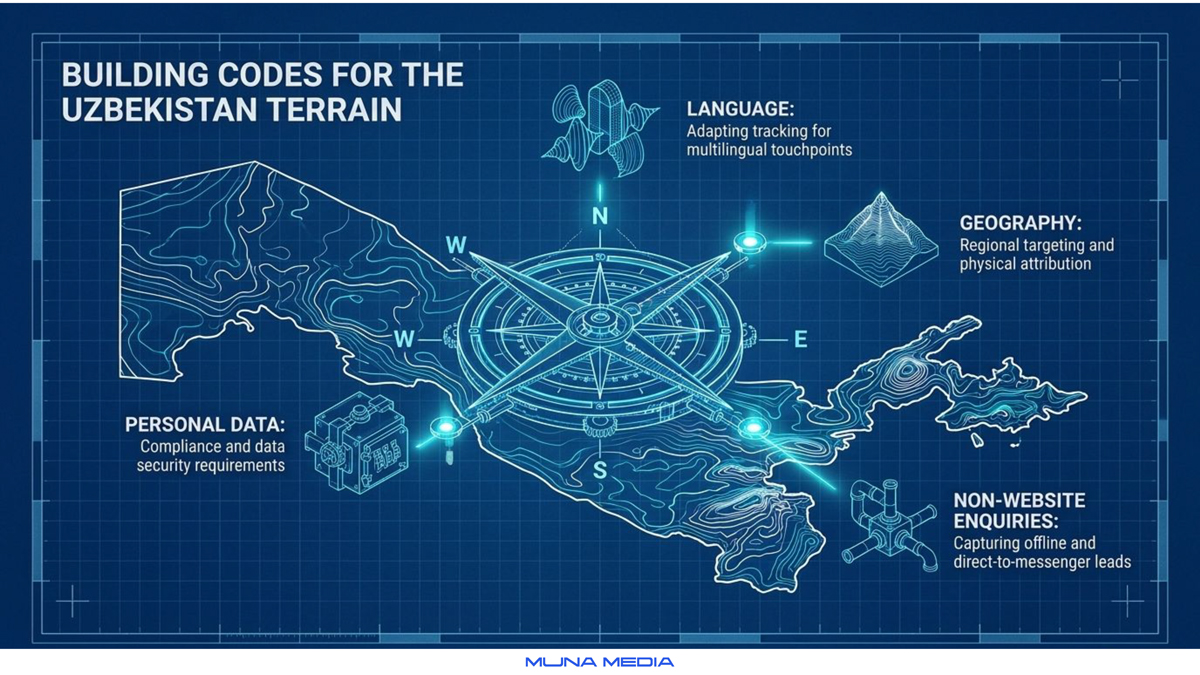
Track language versions separately
Uzbekistan’s Law on Advertising establishes requirements concerning the language of advertising and the conditions for duplicating translations. For measurement, this creates a practical requirement: creative and landing-page language variants should be distinguishable in the data.
Include language in campaign naming, parameters, events and CRM fields. The team can then see not only the combined result but also where a particular version of the message loses the customer. The legal interpretation of specific formats and layouts should be reviewed separately.
Do not mix a Tashkent pilot with the entire country
If Tashkent is the first phase, record the reason, period and expansion rule. City data should not be transferred automatically to all of Uzbekistan. Differences may arise from product availability, delivery, physical locations, sales capacity and channel choice.
Include paths that do not end on the website
A campaign may direct people to a website, telephone call, messenger, app, retail location or partner. Before launch, define which paths exist, which can be measured and which will remain only partially observable.
Design personal-data handling together with measurement
If the system uses a telephone number, email address, customer ID or other personal data, define the purpose, legal basis, data scope, access, retention, transfer and deletion rules before implementation. Uzbekistan’s Law on Personal Data regulates processing, consent, confidentiality and special conditions for storage and processing. A specific architecture requires legal and technical review.
Separate observation, attribution and causal evidence
A responsible measurement system does not promise perfect channel-level causality. It defines which conclusions the available evidence permits.
Five evidence levels are useful:
- Delivery. The advertisement or material was placed and could be seen.
- Interaction. A person completed an observable action.
- Target action. The system recorded an enquiry, registration, call or visit.
- Commercial outcome. CRM, sales or accounting confirmed qualification, order or payment.
- Causal contribution. The research design can estimate what changed because of advertising rather than merely at the same time.

Each higher level requires additional data and a stronger method. Reach does not prove a sale. A sale after a click does not always prove advertising was the sole cause. An attribution report distributes credit according to selected rules, but it does not create a causal experiment by itself. For the detailed boundary between reach and stronger evidence, read “Reach Does Not Prove Advertising Effectiveness”.
Complete the Campaign Measurement Blueprint
The blueprint should be completed before the media plan and analytics implementation brief. It connects the business problem, technical system and operating decision in one document.
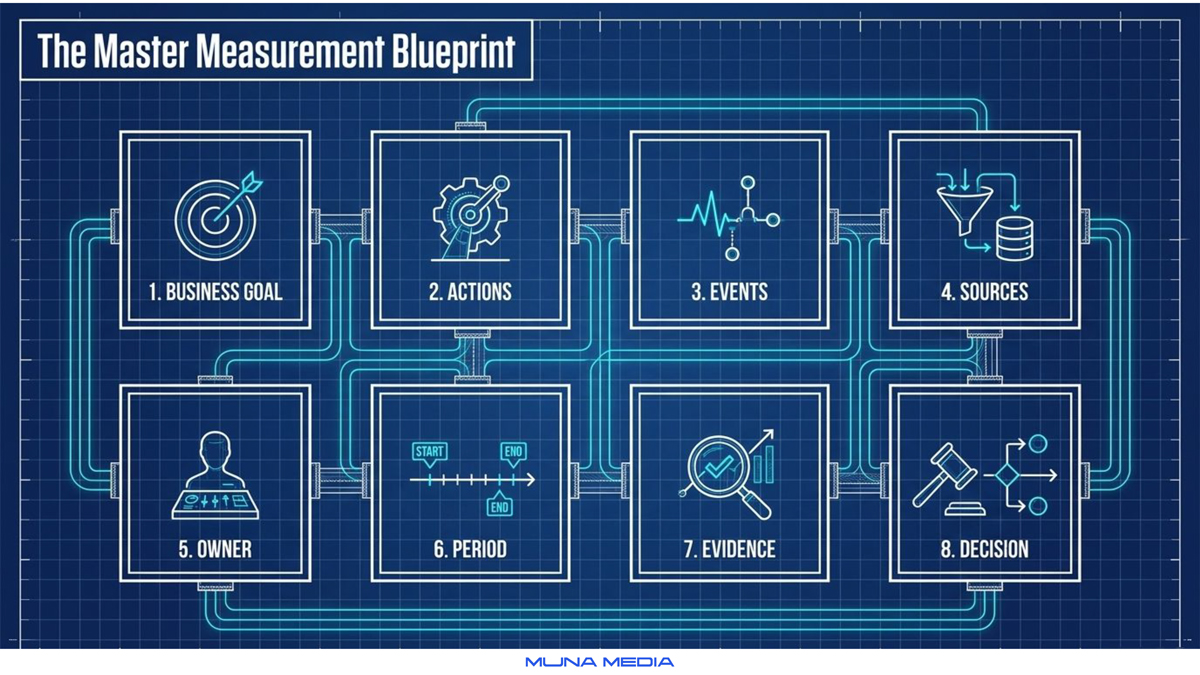
Complete 8 fields:
- Business goal. The change that matters to the company.
- Target action. The action expected from the customer.
- Intermediate events. The steps indicating progress towards the outcome.
- Data source. The system recording each event.
- Data owner. The person accountable for availability and quality.
- Review period. The point at which the team evaluates the signal.
- Evidence level. The conclusion supported by the data.
- Decision. The response to a strong, weak or contradictory result.
The tool does not calculate a supposedly correct ROI or apply universal benchmarks. Its job is to reveal unresolved dependencies before the campaign starts.
Common pre-launch measurement mistakes
Treating an installed tag as finished analytics
A tag may be present while key events, CRM stages and acquisition sources remain disconnected. Test the journey, not the existence of code.
Calling every action a conversion
A page view, click, enquiry, qualification and payment have different value. Give each relevant action a distinct name and owner.
Optimising only for the fastest signal
A quick lead is convenient for an advertising platform but may never qualify. Agree on the intermediate signal and the rule for checking its quality.
Changing definitions during the campaign
If the team changes the qualification rule, review window or exclusions, period comparisons become unreliable. Record every change with a date and reason.
Expecting one report to answer every question
Platform reporting, web analytics, CRM and finance solve different problems. A connected measurement system does not mean one universal number.
Claiming causality without an appropriate design
Without a control group, geographic test, randomisation or another valid method, describe the finding as observation or attribution rather than proven incremental impact.
How Muna Media designs campaign measurement
Muna Media starts with the business decision, not a generic metric list. The team clarifies the product, geography, audience, channels, language variants, customer path, available systems and data limitations. It then creates the event map, assigns ownership, agrees the evidence level and conducts pre-launch quality assurance.

This connects headquarters, the local team, the agency, developers and sales before media goes live. Once data appears, a separate management-reporting system should explain the result, limitations and next decision.
For the financial planning layer, read “Advertising Budget for an Uzbekistan Launch: Building Scenarios Before the Media Plan”. It shows how measurement fits into the complete cost and operating structure of a launch.
{
"@context": "https://schema.org",
"@graph": [
{
"@type": "BlogPosting",
"@id": "https://www.munamedia.me/en/club/marketing-measurement/campaign-measurement-uzbekistan-before-launch#article",
"mainEntityOfPage": {
"@type": "WebPage",
"@id": "https://www.munamedia.me/en/club/marketing-measurement/campaign-measurement-uzbekistan-before-launch"
},
"headline": "How to Design Campaign Measurement in Uzbekistan Before Launch",
"description": "Design campaign measurement before launch: map events, connect website and CRM data, assign owners, test analytics and use a practical blueprint.",
"inLanguage": "en",
"author": {
"@type": "Organization",
"name": "Muna Media Team",
"url": "https://www.munamedia.me/"
},
"publisher": {
"@id": "https://www.munamedia.me/#organization"
},
"about": [
{
"@type": "Thing",
"name": "Campaign measurement"
},
{
"@type": "Place",
"name": "Uzbekistan"
}
]
},
{
"@type": "BreadcrumbList",
"@id": "https://www.munamedia.me/en/club/marketing-measurement/campaign-measurement-uzbekistan-before-launch#breadcrumb",
"itemListElement": [
{
"@type": "ListItem",
"position": 1,
"name": "Muna Media",
"item": "https://www.munamedia.me/"
},
{
"@type": "ListItem",
"position": 2,
"name": "Blog",
"item": "https://www.munamedia.me/en/club"
},
{
"@type": "ListItem",
"position": 3,
"name": "Marketing Measurement",
"item": "https://www.munamedia.me/en/club/marketing-measurement"
},
{
"@type": "ListItem",
"position": 4,
"name": "How to Design Campaign Measurement in Uzbekistan Before Launch",
"item": "https://www.munamedia.me/en/club/marketing-measurement/campaign-measurement-uzbekistan-before-launch"
}
]
},
{
"@type": "FAQPage",
"@id": "https://www.munamedia.me/en/club/marketing-measurement/campaign-measurement-uzbekistan-before-launch#faq",
"mainEntity": [
{
"@type": "Question",
"name": "What must be configured before an advertising campaign launches?",
"acceptedAnswer": {
"@type": "Answer",
"text": "At minimum, define target actions, events, data sources, campaign parameters, CRM stages, owners and decision rules. The team should then complete a test enquiry through the entire available path to qualification or sale."
}
},
{
"@type": "Question",
"name": "Can advertising be measured without a CRM?",
"acceptedAnswer": {
"@type": "Answer",
"text": "Part of the journey can be measured, but the conclusions will be limited. Web analytics can show visits and on-site actions, but confirming enquiry quality, sales, returns and repeat purchases is more difficult without a CRM or another reliable register."
}
},
{
"@type": "Question",
"name": "How should calls and messenger enquiries be measured?",
"acceptedAnswer": {
"@type": "Answer",
"text": "Each path needs its own recording method. This may be a telephone number, enquiry ID, source field, promotion code or CRM integration. The method must be tested before launch and its limitations documented."
}
},
{
"@type": "Question",
"name": "How is attribution different from causal impact?",
"acceptedAnswer": {
"@type": "Answer",
"text": "Attribution distributes credit according to selected rules, while causal analysis estimates what changed because of advertising. A causal conclusion normally requires a stronger research design than a standard clicks-and-conversions report."
}
},
{
"@type": "Question",
"name": "Who should own campaign measurement?",
"acceptedAnswer": {
"@type": "Answer",
"text": "One person should own the complete measurement system, although several teams create the data. Marketing, the agency, developers, sales and finance should know their tasks, deadlines and control points before launch."
}
},
{
"@type": "Question",
"name": "How can a team confirm that analytics is launch-ready?",
"acceptedAnswer": {
"@type": "Answer",
"text": "Complete a test path from the advertising link to the final available system. Check events, parameters, identifiers, CRM stages, access permissions, test-data exclusions and the final result seen by the measurement owner."
}
},
{
"@type": "Question",
"name": "Can every advertising channel be measured precisely?",
"acceptedAnswer": {
"@type": "Answer",
"text": "Not always. The answer depends on the channel, customer path, available data and research design. Before launch, define where attribution is possible, where only observation is realistic and where a stronger test of causal contribution can be designed."
}
}
]
}
]
}
Contact Us
Do you have any questions?
Send us an email or a message on Telegram, or check out our contact section for more ways to get in touch.
Send us an email or a message on Telegram, or check out our contact section for more ways to get in touch.
SOLUTIONS
OUTDOOR ADVERTISING
Discuss your project with one of our top manager
Receive comprehensive information on how to acquire new clients, boost your business, or develop an exciting project with us.
By clicking, you agree to our privacy policy.