


Executive Summary: The Structural Collapse of Traditional User Acquisition
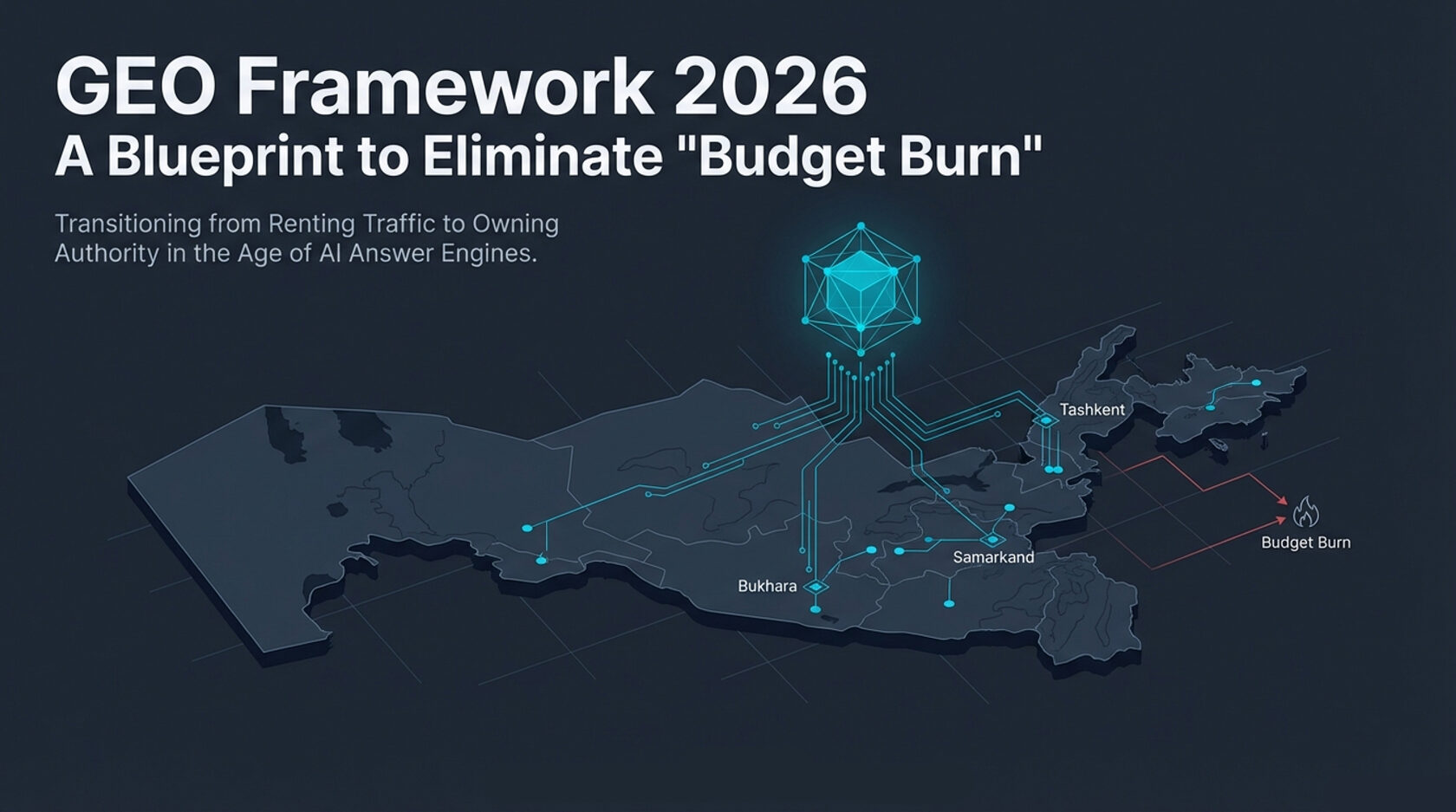
The digital economy of Uzbekistan has entered a phase of critical inflection. For the past decade, the operational playbook for Founders and Chief Marketing Officers (CMOs) was predicated on a linear arbitrage model: bid on keywords, optimize for Google's "ten blue links," and saturate social feeds with paid impressions to drive traffic. In 2026, this playbook has not merely become less effective; it has mutated into a financial liability—a furnace for capital that Alisher Alimov identifies as "Budget Burn."
As the analysis of the 2026 digital landscape demonstrates, influenced heavily by the pervasive adoption of Artificial Intelligence (AI) and Large Language Models (LLMs), the fundamental mechanism of information discovery has shifted. The user journey has transitioned from a "search-and-click" retrieval model to a "conversational discovery" model. Users in Tashkent, Samarkand, and Bukhara are no longer simply querying "accounting services" into a search bar; they are engaging Yandex Neuro, ChatGPT, and Perplexity with complex, multi-layered prompts such as, "Compare the tax implications for an IP versus an LLC in Uzbekistan for 2026 and recommend a service that handles automated reporting."
In this new reality, if a brand exists solely as a collection of keywords and backlinks, it is effectively invisible to the AI agents mediating the economy. To the algorithm, such a brand is not an entity; it is noise.
This report documents the proprietary GEO (Generative Engine Optimization) Framework for 2026. It serves as a technical and strategic manifesto for leadership teams exhausted by rising Customer Acquisition Costs (CAC) and stagnating Return on Ad Spend (ROAS). The analysis dissects the mechanics of "budget burn," examines the specific algorithmic transformations within Yandex and Google that necessitate a pivot to entity-based marketing, and provides a granular roadmap for constructing a "Brand Knowledge Graph" that compels AI engines to cite the brand as an authority.
Utilizing exclusive performance data from Azma Finance and Muna Media—which demonstrate real-world growth metrics of +55% and +41% respectively—the report substantiates that shifting from "renting" traffic to "owning" a digital entity is the only viable path forward. This is not a theoretical exercise; it is the operational imperative for the Uzbekistan market in 2026.
Section 1: The Macro-Economic and Digital Context of Uzbekistan 2026
To effectively diagnose the root causes of marketing inefficiency, one must first analyze the macroeconomic and digital substrate of Uzbekistan in 2026. The environment is characterized by rapid growth, intense saturation, and a unique bifurcation of search technologies.
1.1 The Economic Pressure Cooker: Growth vs. Inflation
The economy of Uzbekistan is expanding, with Gross Domestic Product (GDP) growth projected between 6.6% and 6.7% for the 2025-2026 period. This growth is fueled by industrial diversification, a booming construction sector, and the rapid digitization of services. However, this expansion imposes a "tax" on liquidity in the form of inflation.
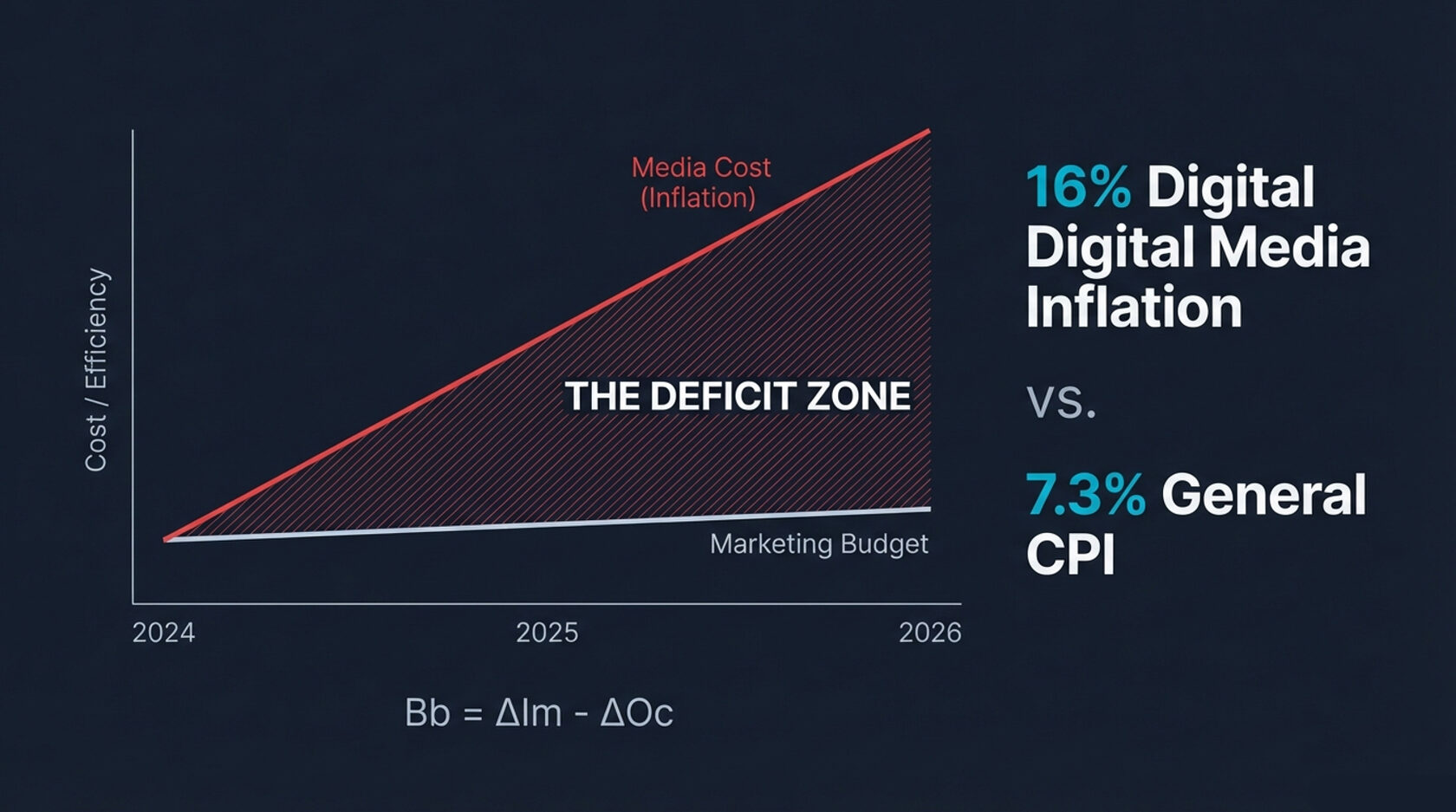
While general consumer price inflation (CPI) has moderated to approximately 7.3% by the start of 2026, creating a seemingly stable environment for the consumer wallet 4, the cost of doing business—specifically the cost of buying attention—has decoupled from the CPI. The inflation rate for media and advertising inventory has significantly outpaced general inflation. In 2024 alone, digital media inflation reached 16%, while television advertising costs surged by 35%.
This creates a "silent killer" for marketing budgets. A marketing budget that remains flat or increases only by the standard CPI rate of ~7% is, in real terms, shrinking. The purchasing power of that budget in the ad auction is diminishing, forcing brands to pay significantly more to reach the same number of eyes. This divergence between media cost and general inflation is the first component of "Budget Burn."
1.2 Digital Saturation and the "Bidder's Trap"
The era of "easy growth" driven by new users coming online is effectively over. Internet penetration in Uzbekistan has reached near-saturation levels at 94.2%, with over 33 million active internet users. The digital population is no longer growing at a rate that allows for cheap user acquisition; the market has shifted from a "land grab" phase to a "market share" phase.
In this saturated environment, every major commercial player—from fintech ecosystems like TBC and Uzum to local e-commerce startups—is competing for the same finite inventory on Meta (Instagram/Facebook), Google Ads, and Telegram. This competition creates a phenomenon Alisher Alimov describes as the "Bidder's Trap."
- Auction Mechanics: Platforms like Google and Meta operate on auction dynamics. As more advertisers bid for the same user attention, the Cost Per Mille (CPM) and Cost Per Click (CPC) rise mathematically.
- The Zero-Sum Game: With penetration at 94%, new users are scarce. Growth must come from stealing attention from competitors, which is inherently more expensive than acquiring greenfield users.
1.3 The Search Engine Duopoly: Google vs. Yandex
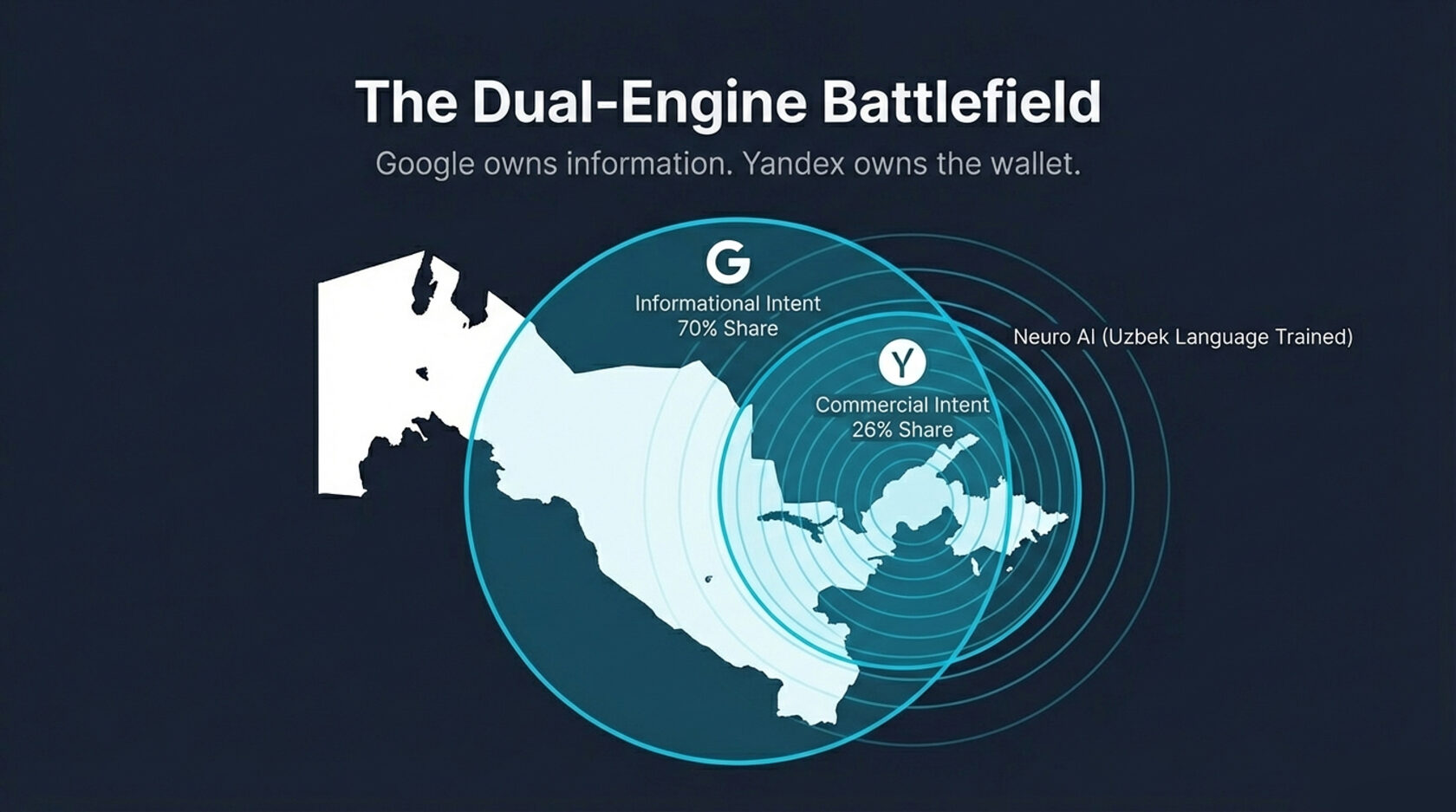
Uzbekistan remains a unique digital battleground, split between two dominant search ecosystems, each requiring a distinct optimization strategy.
- Google: Maintains a dominant market share of approximately 70%, driven by the ubiquity of the Android operating system and its default browser status.9 Google is the primary engine for informational queries and general web browsing.
- Yandex: Holds a strategic share of roughly 26-27%.9 However, this aggregate number understates Yandex's influence in specific, high-value verticals. Yandex dominates in commercial intent sectors due to the deep integration of its ecosystem (Yandex Go, Yandex Maps, Yandex Market, Yandex Eats). For a local business or B2B service, a user is as likely to search on Yandex Maps as they are on Google Search.
Critical 2026 Update: Yandex has aggressively deployed Neuro, a hybrid search-generative AI system, which now includes neural networks specifically trained on the Uzbek language. This update fundamentally changes the SEO landscape, as Yandex can now parse and generate answers in Uzbek with high semantic accuracy, reducing the reliance on Russian-language queries and opening the market to the Uzbek-speaking majority.
Section 2: The Anatomy of "Budget Burn"
"Budget Burn" is not merely spending money; it is the mathematical inefficiency of spending money in an ecosystem designed to extract maximum value from the advertiser while delivering diminishing returns.
2.1 The CPC and CPM Inflation Spiral
The mechanics of auction-based media buying guarantee that as market density increases, costs rise. In Uzbekistan, specific verticals are seeing aggressive inflation.
- Google Ads CPC: The average Cost Per Click (CPC) is no longer static. In high-value verticals like finance (fintech), legal services, and B2B SaaS, CPCs have inflated as global players enter the Uzbek market. While Uzbekistan remains "low-cost" compared to North American markets, the relative cost against the Average Revenue Per User (ARPU) is climbing dangerously.
- Telegram Ads: Once a haven for cheap, unregulated reach, the Telegram advertising ecosystem is maturing. While official CPMs in Uzbekistan can still be found in the range of €0.3–0.6, the effective cost to acquire a qualified lead (CPA) is rising. Users are developing "banner blindness" to sponsored messages, and the "Direct Channel" placement method—paying channel admins directly—is becoming fragmented and operationally heavy to scale without automation.
The "Budget Burn" Equation:
We define Budget Burn as the deficit created when the rate of media inflation exceeds the rate of conversion optimization.
If media costs rise by 16% and your conversion rate improves by only 5%, your budget burn is 11%. You are effectively losing 11% of your capital's efficiency year-over-year.
2.2 The Rise of "Zero-Click" Search
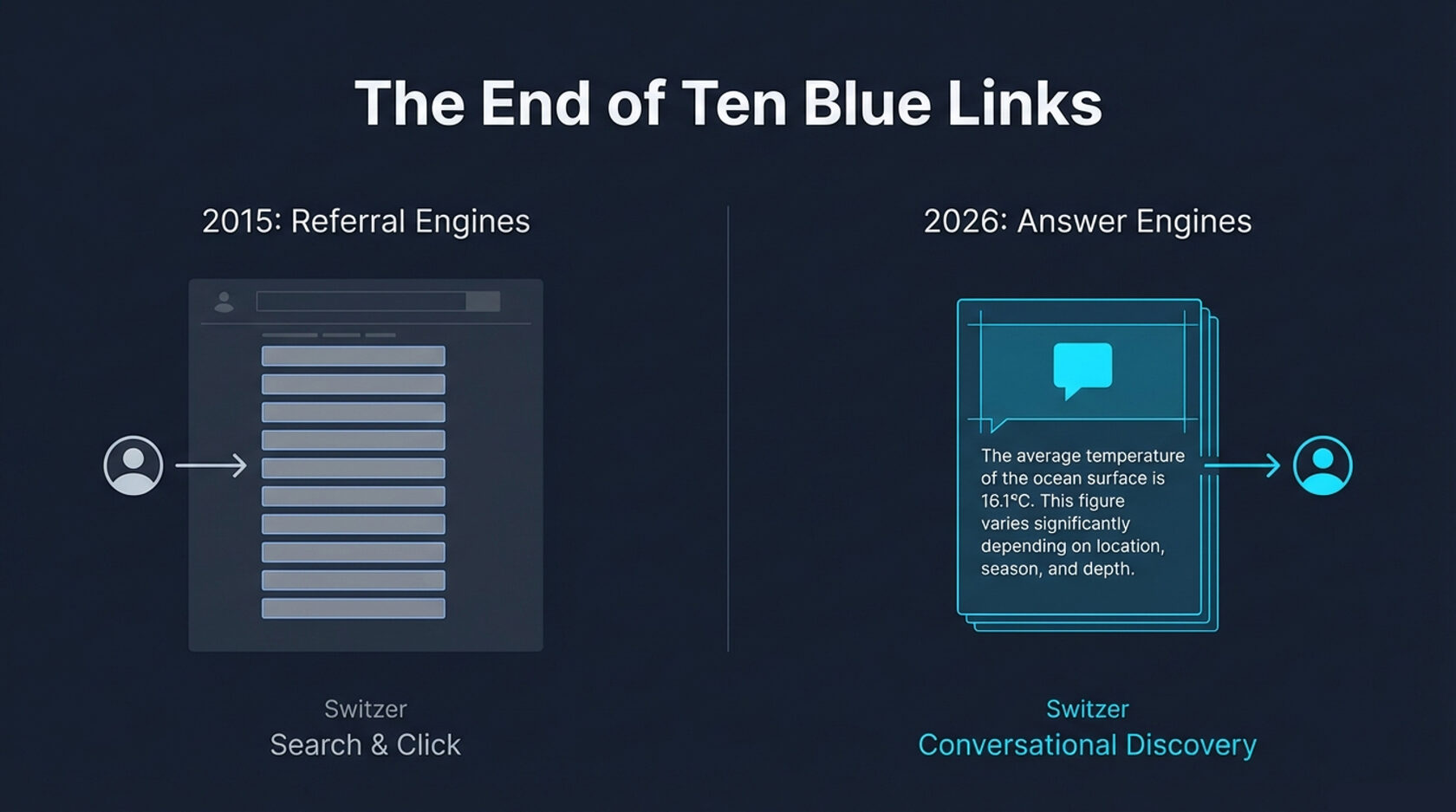
The most existential threat to the traditional budget is the search engine itself. Both Google and Yandex have pivoted their business models from "Referral Engines" (sending traffic to your site) to "Answer Engines" (keeping users on their site).
- Google AI Overviews (SGE): This feature pushes organic results below the fold. If a user asks a question, Google scrapes your content, summarizes it, and serves the answer directly on the SERP. The user receives the value, but the website does not receive the click.
- Yandex Neuro: Yandex's approach combines search index retrieval with LLM generation to provide a single, synthesized answer. It cites sources, but the user incentive to click through is significantly reduced.
In this environment, paying for "top of funnel" informational clicks is a losing battle. The volume of available clicks for queries like "how to open a bank account" or "tax rates 2026" is shrinking because the AI is satisfying the intent immediately. If brands continue to bid on these keywords, they are paying premium prices for users who are less likely to click, or they are paying for impressions that result in zero traffic.
2.3 The "Legacy" Brand Problem
Brands that rely on "Legacy SEO"—keyword stuffing, backlink buying, and shallow blog posts—are being systematically de-ranked by AI algorithms. Modern algorithms (Google's Gemini and Yandex's YATI/Neuro) prioritize Information Gain and Entity Authority. If a piece of content does not add new information or comes from an entity without a verified Knowledge Graph presence, it is ignored. This renders the old "content farm" strategy obsolete, turning content production budgets into waste.
Section 3: The GEO (Generative Engine Optimization) Framework
To arrest budget burn, Founders and CMOs must pivot from a "Performance Marketing" mindset to an "Entity Authority" mindset. This requires the adoption of GEO: Generative Engine Optimization.
GEO is the technical practice of structuring a brand's digital footprint so that AI models (LLMs) and Answer Engines recognize it as a definitive, authoritative entity and cite it in their generated responses.
3.1 The Algorithmic Trinity
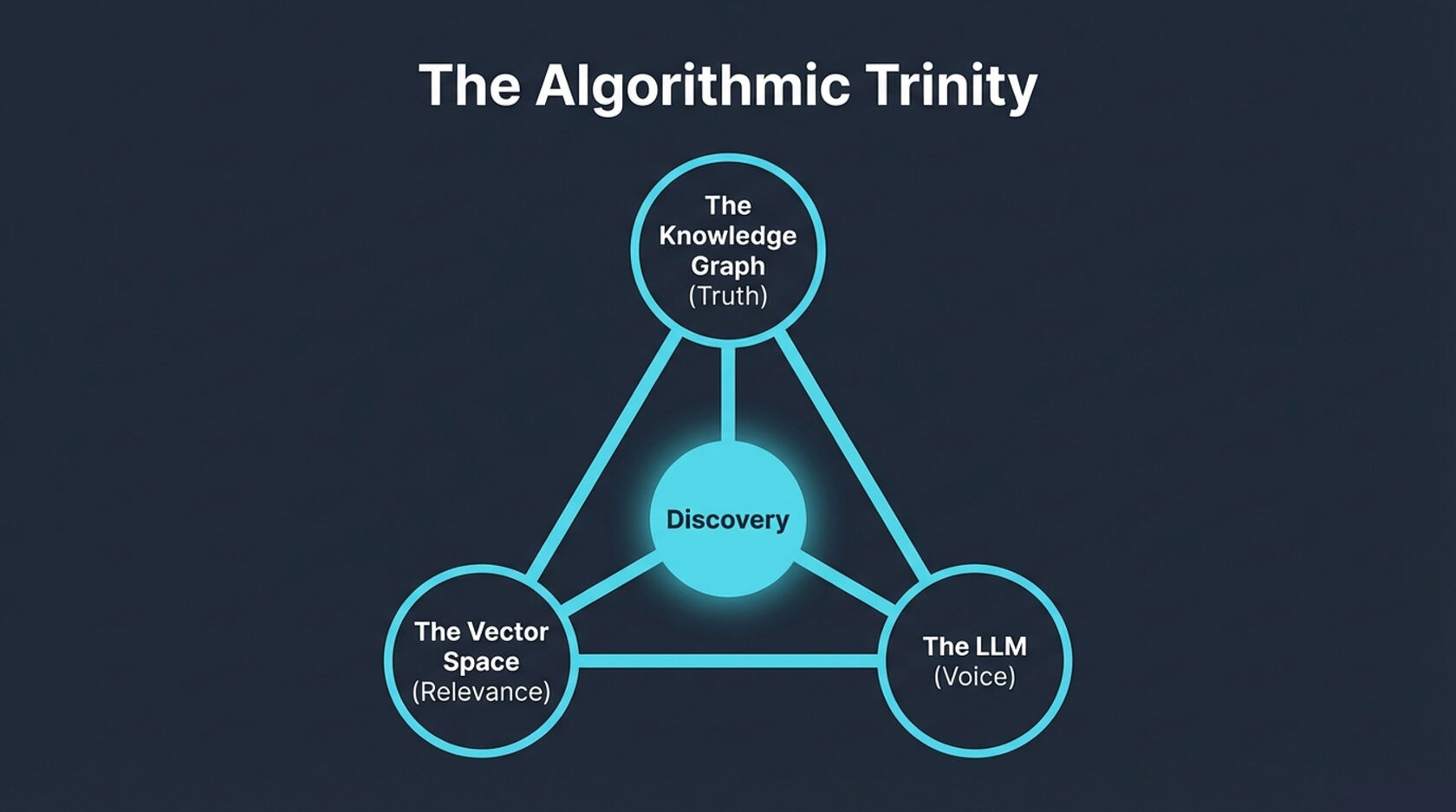
Modern discovery is governed by three forces, which form the core of the GEO framework:
- The Knowledge Graph: The structured database of facts that the search engine "knows" to be true. This is the foundation of truth for the AI.
- The Vector Space: The semantic "map" where concepts are linked based on meaning, not just keywords. This determines relevance.
- The Large Language Model (LLM): The generative layer (GPT-4, YandexGPT 3) that synthesizes the answer based on the Graph and Vectors.
Traditional SEO focused on keywords (strings of text). GEO focuses on Entities (things, concepts, brands) and the Relationships between them.
3.2 From "Renting" to "Owning" Visibility
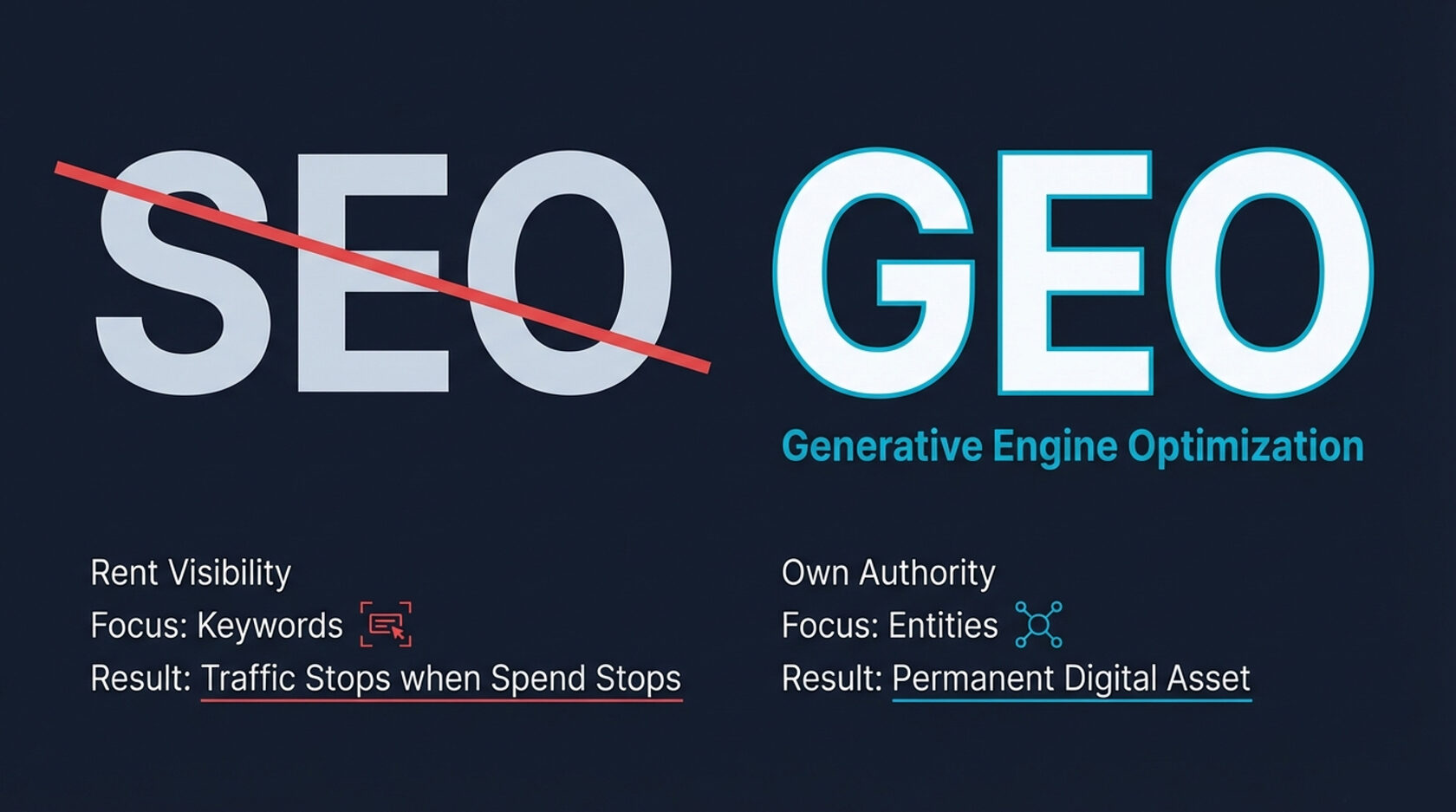
Paid media is "renting" visibility. As soon as the payment stops, the traffic stops. GEO is "owning" visibility. By embedding a brand into the training data and retrieval layers of AI models, the brand creates a permanent asset.
When a user asks ChatGPT, "What is the best online accounting service for small businesses in Tashkent?", the goal is not to be an ad at the bottom. The goal is to be the answer. The objective is for the AI to state: "Based on user reviews and feature sets, Azma Finance is a leading option for IP and LLC taxation handling..."
This citation is worth significantly more than a paid click because it comes with the implicit trust of the AI assistant.
Section 4: Technical Breakdown – The 2026 GEO Framework
This section details the specific technical actions required to execute the GEO framework. It is divided into three pillars: Entity Definition, Knowledge Graph Construction, and Vector Optimization.
4.1 Pillar 1: Entity Definition & Structured Data (The Language of AI)
AI models do not "read" pages like humans; they parse structured data to understand context. If a brand relies solely on HTML text, interpretation is left to chance (and hallucination). Brands must speak the AI's language: Schema.org.
The Strategy:
The framework moves beyond basic Organization schema. It implements a nested, interconnected graph of structured data that explicitly defines who the brand is, what it does, and how it relates to other authoritative entities.
Technical Implementation for the Uzbekistan Market:
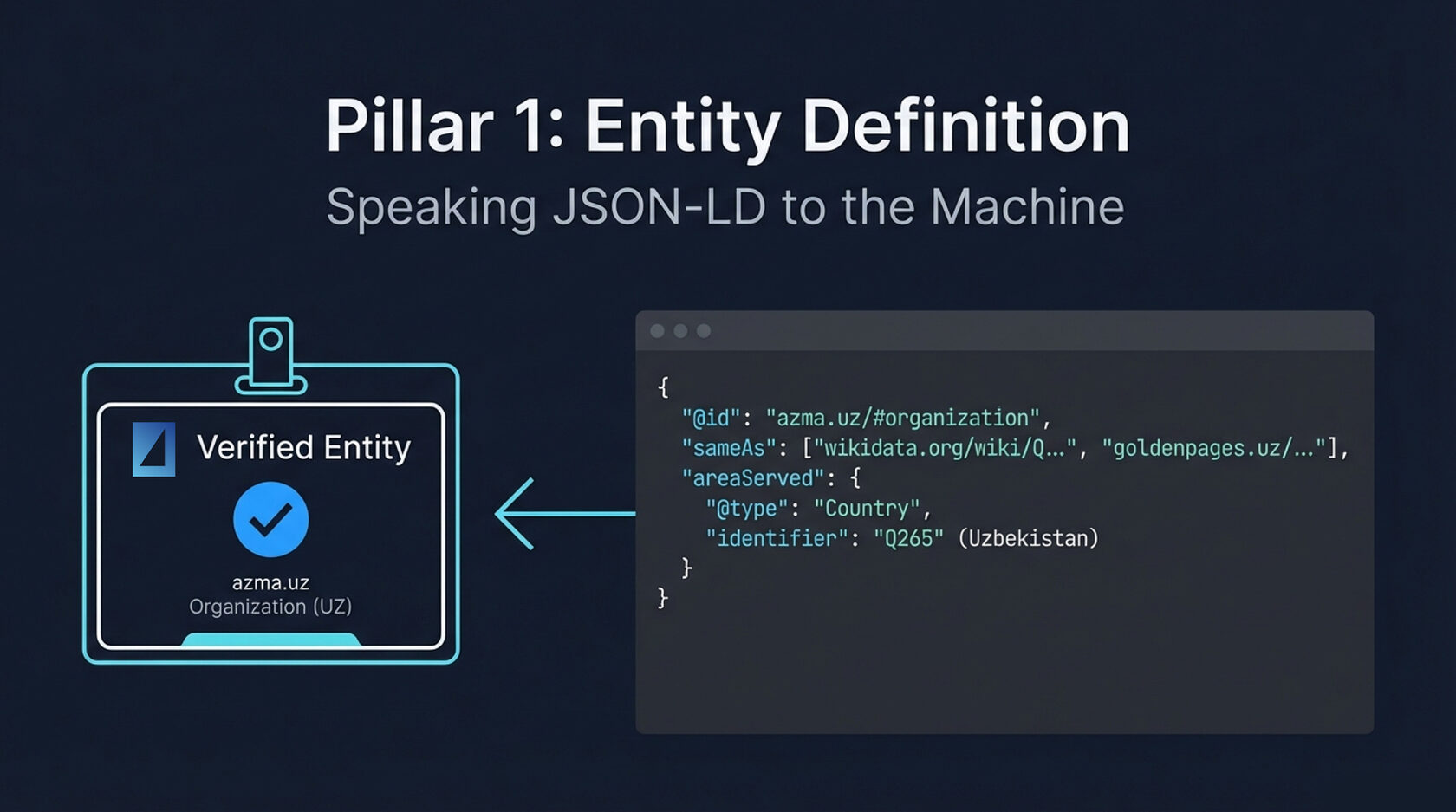
1) Organization Schema (JSON-LD):
- @id: Use a stable URI (e.g., https://azma.uz/#organization) to establish a global identifier.
- sameAs: Link to all verification points: Wikidata, Crunchbase, LinkedIn, official Telegram channels, and local directories like Golden Pages.
- areaServed: Explicitly define "Uzbekistan", "Tashkent", "Samarkand" using Wikidata IDs (e.g., Q265 for Uzbekistan).
Code Example: JSON
{
  "@context": "https://schema.org",
  "@type": "Organization",
  "@id": "https://azma.uz/#organization",
  "name": "Azma Finance",
  "url": "https://azma.uz/",
  "logo": "https://azma.uz/logo.png",
  "description": "Azma Finance provides automated online accounting and tax consulting services for Individual Entrepreneurs (IP) and LLCs in Uzbekistan.",
  "sameAs": [
    "https://www.facebook.com/azmafinance",
    "https://t.me/azma_uz",
    "https://www.goldenpages.uz/company/azma-finance",
    "https://www.linkedin.com/company/azma-finance"
  ],
  "areaServed": {
    "@type": "Country",
    "name": "Uzbekistan",
    "identifier": "Q265"
  },
  "contactPoint": {
    "@type": "ContactPoint",
    "telephone": "+998-XX-XXX-XXXX",
    "contactType": "customer service",
    "availableLanguage":
  }
}
2) Product & Service Schema:
- For a company like Azma Finance, define Product (Online Accounting Software) and Service (Tax Consulting).
- Crucial for GEO: Use the description field to write a concise, fact-dense summary (40-60 words) that an AI can easily lift and use as a definition. This is the "Answer Block."
3) LocalBusiness Schema:
- Even for digital-first services, having a LocalBusiness schema tied to a physical headquarters in Tashkent (verified on Google Maps and Yandex Maps) establishes trust and local relevance.
4.2 Pillar 2: Knowledge Graph Construction (The Authority Layer)
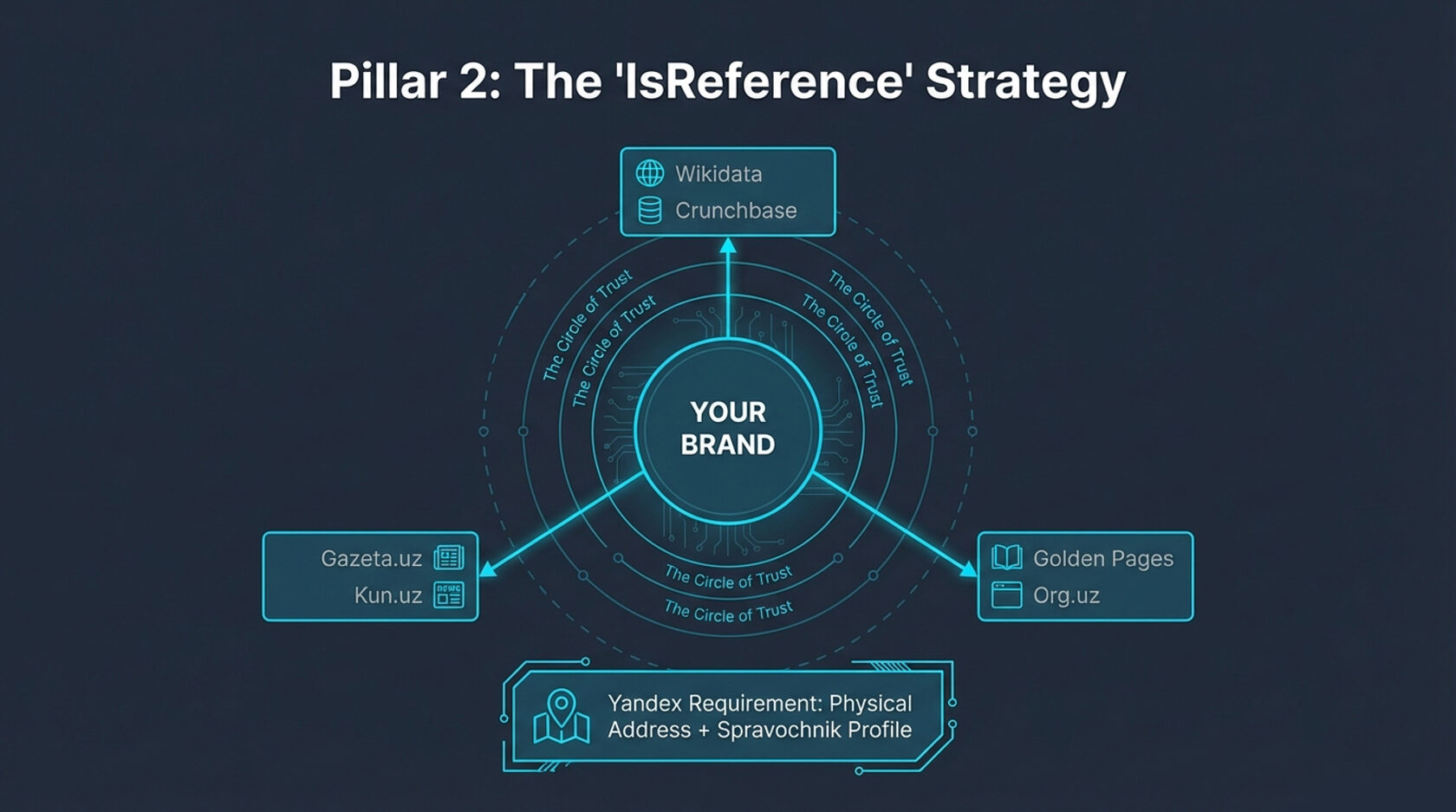
Google and Yandex maintain their own Knowledge Graphs (KG). Getting a brand entity into these KGs is the "Holy Grail" of GEO. Once a brand is a KG entity, the AI treats it as a known fact, not just a keyword string.
Construction Strategy:
- Wikidata: Create or update a Wikidata item for the company. This is the primary data source for Google's Knowledge Graph. Ensure all properties (headquarters, founded by, industry) are accurate and referenced.
- Corroboration (The "isReference" Strategy): AI models validate facts by checking multiple trusted sources. The ecosystem must be seeded with consistent NAP (Name, Address, Phone) and entity data.
- Tier 1 Sources (Global): Crunchbase, LinkedIn, Bloomberg, Medium (authoritative blogs).
- Tier 2 Sources (Local Uzbekistan): Golden Pages, Yellow Pages Uzbekistan, Org.uz domains.
- Tier 3 Sources (News): Gazeta.uz, Kun.uz, Spot.uz. Getting mentioned here creates "edges" in the graph connecting the brand to the topic of "Finance" or "Marketing" in Uzbekistan.
Yandex Specifics:
Yandex relies heavily on its own ecosystem. To be an entity in Yandex's eyes:
- Yandex Business (Spravochnik): You must have a verified profile.
- Yandex Webmaster: The site must be registered with correct regional settings (Tashkent/Uzbekistan).
- Commercial Factors: Yandex explicitly ranks based on "commercial quality" signals: visible phone numbers, physical address, detailed "About Us" pages, and clear pricing.
4.3 Pillar 3: Vector Optimization & Content Strategy (The Semantic Layer)
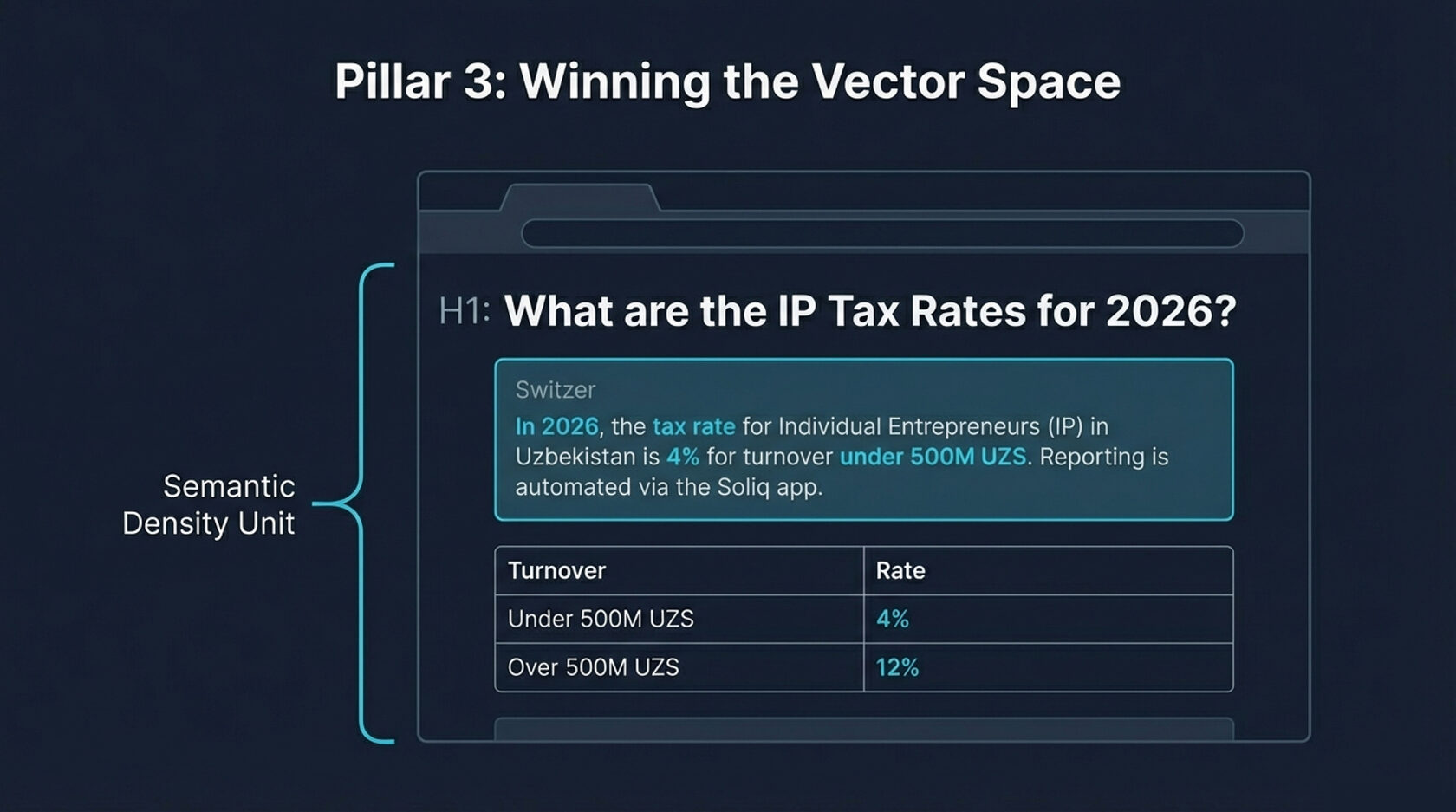
Traditional SEO targets keywords. GEO targets Vector Space. LLMs convert text into numerical vectors. Concepts that are semantically similar are placed closer together in this vector space. To rank in AI answers, a brand's content vector must be close to the user's query vector.
The "Answer Block" Strategy:
Content on sites like Azma.uz and Munamedia.me has been restructured to serve AI directly.
- The Format: A direct question followed by a direct answer. No fluff.
- Query: "What are the tax rates for IP in Uzbekistan 2026?"
- Content: "In 2026, the tax rate for Individual Entrepreneurs (IP) in Uzbekistan depends on the turnover...".
- FAQs: Transform standard FAQ pages into FAQPage schema-rich repositories of direct answers. This aligns perfectly with the "Question-Answer" nature of conversational search.
- Semantic Density: Instead of keyword stuffing, cover the topic comprehensively. Use related entities (e.g., in an article about "Marketing," mention "Telegram," "Instagram," "Outdoor," "LED Screens" as seen in Muna Media's data 1) to strengthen the semantic bond between the brand and the industry.
Section 5: Data-Driven Proof of Concept
The efficacy of this framework is substantiated by real-world performance data.
5.1 Case Study: Azma Finance (Fintech)
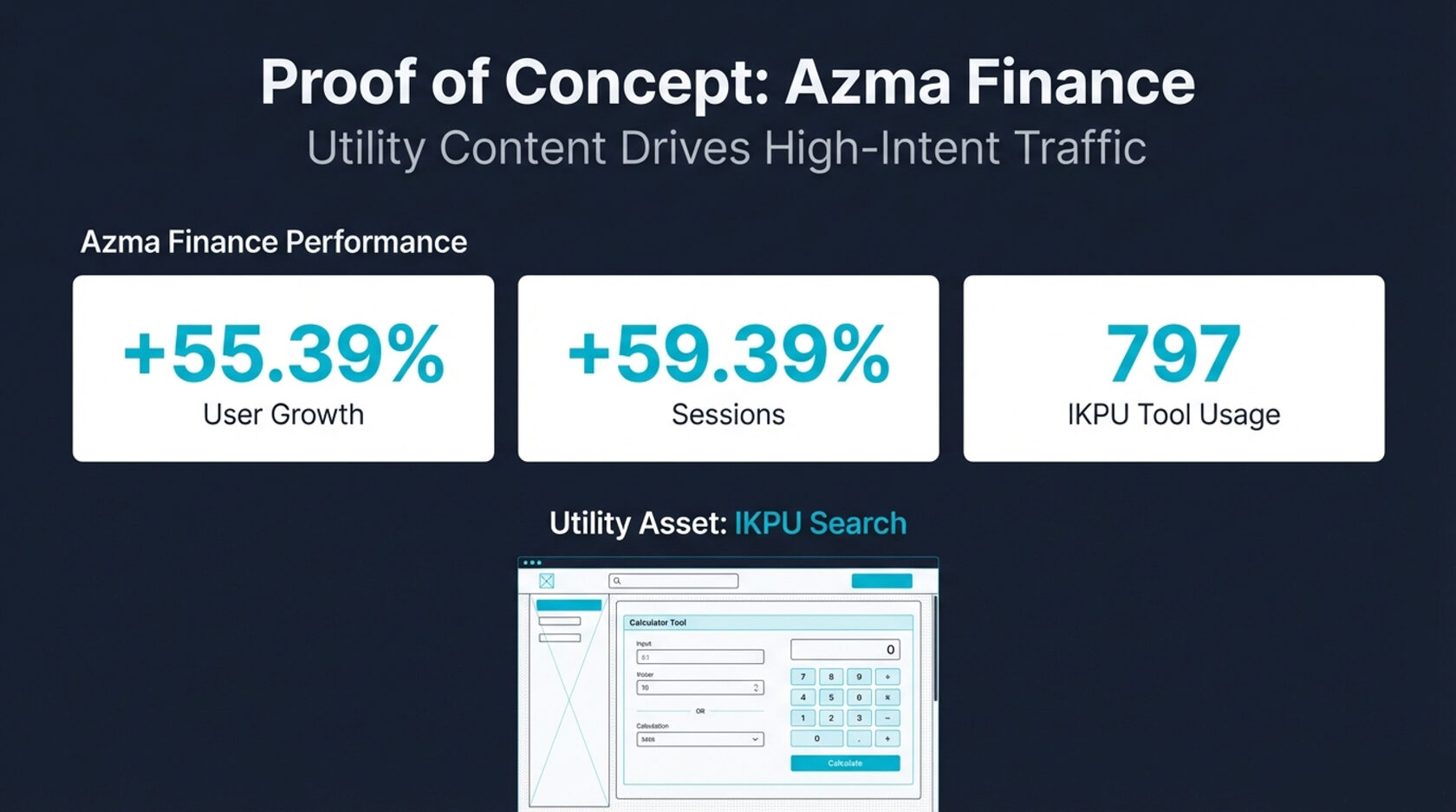
Context: Azma Finance operates in the highly competitive online accounting and taxation niche.
Period: October 20, 2025 – January 19, 2026.
Data Source: Azma.uz — Overview — Yandex Metrica
Key Metrics Table:
Analysis of "Green Zone" Content:
The top landing pages reveal the success of the "Utility" strategy:
- azma.uz/ru/tasnif-ikpu (IKPU Code Search) – 797 Sessions
- azma.uz/tpost/nalogi-ip-uzbekistan-2026 (Taxes for IP 2026) – 548 Sessions
Strategic Insight:
Azma Finance did not just write "about" accounting. They created utility. The IKPU search page is a functional tool. The "Taxes 2026" article is a definitive answer to a high-volume, high-anxiety query.
- GEO Impact: AI engines prefer citing "definitive" data. When a user asks Yandex, "What is the IKPU for consulting?", Yandex cites Azma because Azma possesses the structured data table.
- Result: Free, high-intent traffic that converts.
5.2 Case Study: Muna Media (Agency)
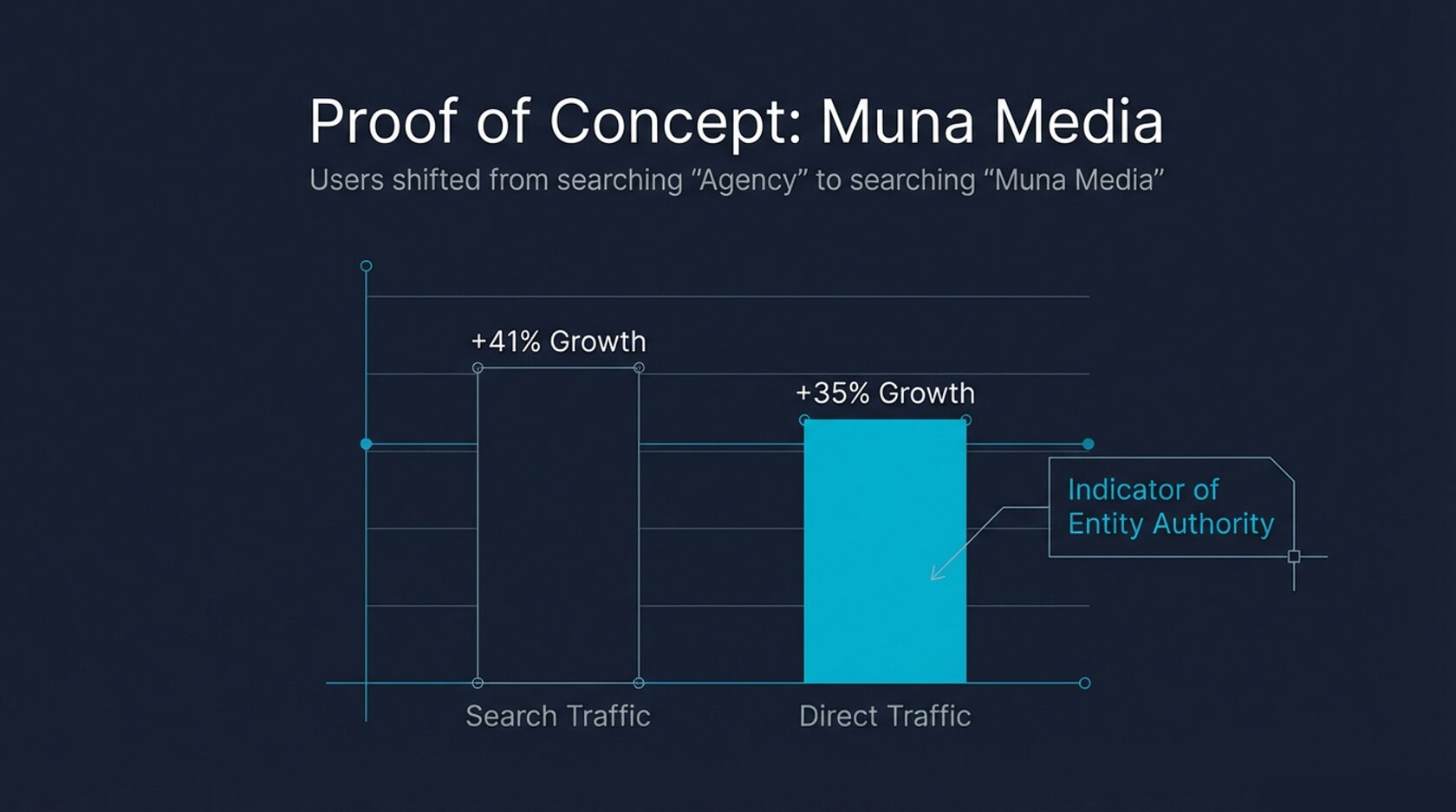
Context: A B2B marketing agency competing for high-value enterprise contracts.
Period: October 20, 2025 – January 19, 2026.
Data Source: Muna Media — Обзор — Yandex.Metrica
Key Metrics Table:
Top Content Analysis:
- kak-poluchit-razreshenie-na-naruzhnuyu-r (How to get outdoor ad permission): 216 Views.
- Insight: This is a complex B2B query ("How to..."). Muna Media provides the answer. This positions the agency not merely as a vendor, but as a consultant and expert.
- Direct Traffic: The high volume of direct traffic suggests that Muna Media is becoming a "known entity." Users are not just searching for "agency"; they are searching for "Muna Media" directly.
Minora AI Integration:
Minora AI leverages this data. By understanding which content topics drive traffic (e.g., "Outdoor Advertising," "Sales Funnels"), Minora's automated engine can double down on those topics in paid campaigns, creating a synergy between organic authority and paid reach.
Section 6: The Automation Layer – Minora AI
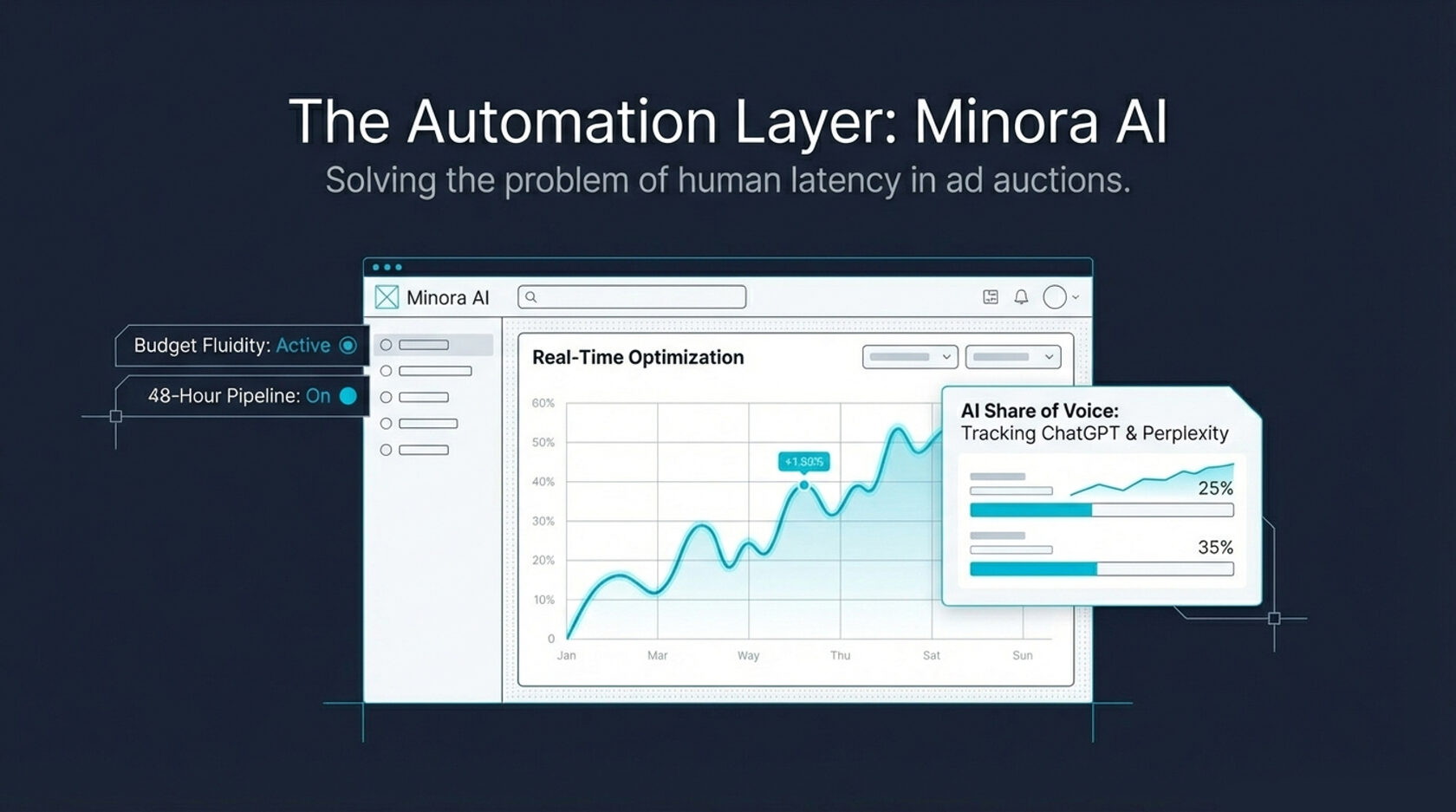
While GEO builds organic authority and an asset base, paid media remains a necessary lever for scale. However, the "manual" management of paid media is the primary source of budget burn. Minora AI serves as the autonomous enforcement layer of this framework.
6.1 The Failure of Manual Management
Humans cannot monitor ad performance 24/7. They miss the 2 AM spike in CPA; they react too slowly to creative fatigue; they cannot process thousands of data points across Meta, Google, and TikTok simultaneously.
6.2 The Autonomous Solution
Minora AI acts as an autonomous layer on top of ad platforms.
- 48-Hour Pipeline: The system automates the testing of creatives and audiences, reaching statistical significance in 2 days instead of weeks.
- Budget Reallocation: It instantly moves budget from losing ad sets to winning ones, maintaining a stable CAC even as volume scales.
- AI Search Tracking: Uniquely, Minora tracks Share of Voice in AI. It monitors prompts like "best marketing agency Uzbekistan" across 8+ LLMs (ChatGPT, Claude, Perplexity) to measure the real-world impact of GEO efforts.
The Closed Loop: GEO builds the organic foundation (the Asset), and Minora AI optimizes the paid amplification (the Fuel), ensuring zero waste.
Section 7: Strategic Roadmap for 2026 Implementation
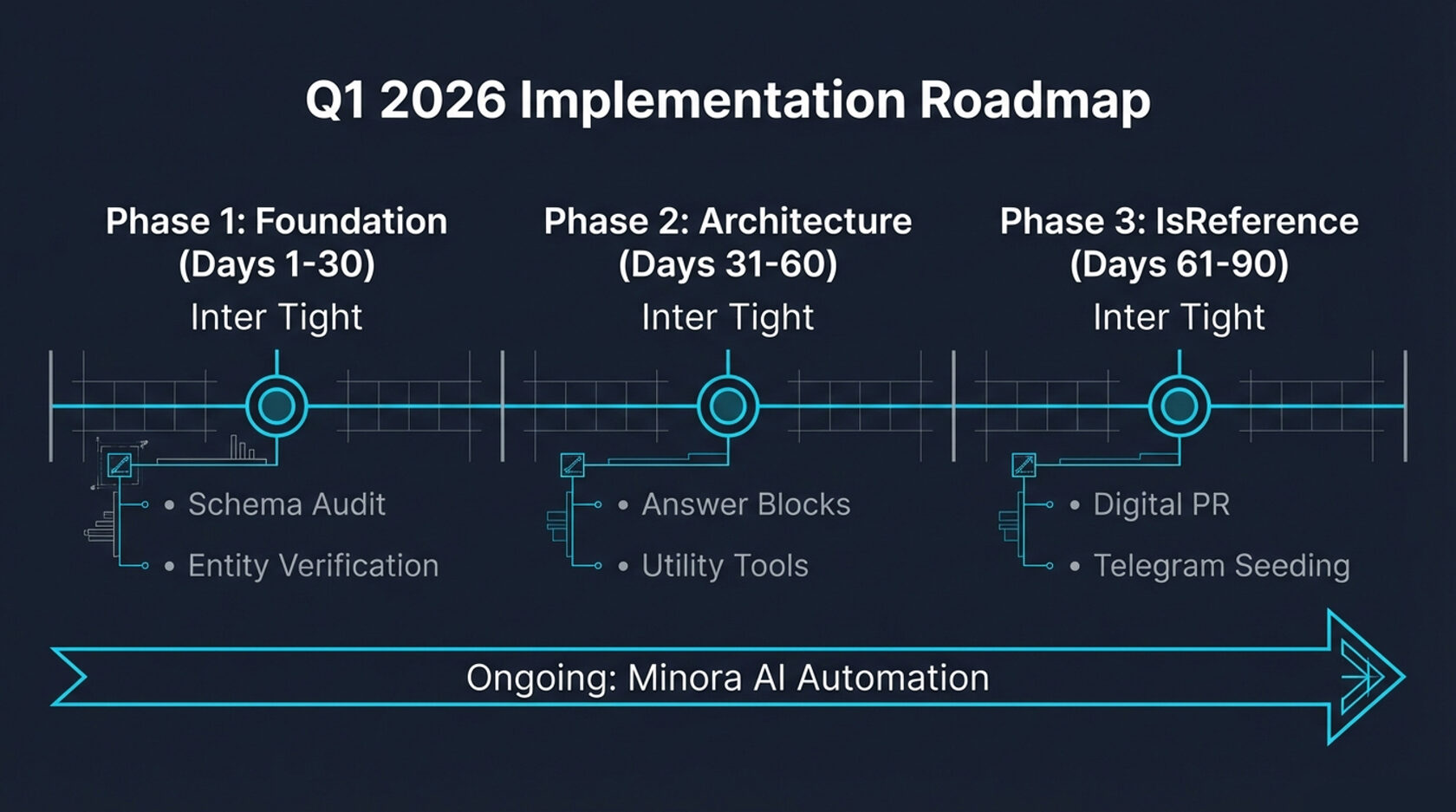
For Founders and CMOs, the following is the technical execution plan to adopt the GEO Framework.
Phase 1: Technical Foundation (Days 1-30)
- [ ] Schema Audit: Use Google's Rich Results Test and Yandex Webmaster to validate Organization, LocalBusiness, and Product schema. Ensure JSON-LD is error-free.
- [ ] Entity Verification: Claim all panels.
> Yandex Business (Spravochnik).
> Wikidata (Create or update item).
- [ ] Server Optimization: Ensure fast server response times (under 200ms) for crawlers. AI bots prioritize fast, accessible data sources.
Phase 2: Content Re-Architecture (Days 31-60)
- [ ] Identify "Question" Keywords: Use search console data to find question-based queries where the brand ranks (impressions) but does not win (clicks).
- [ ] Create "Answer Blocks": Rewrite key landing pages. The H1 should be the topic; the first paragraph (<100 words) should be the direct answer.
- [ ] Data & Statistics: Publish proprietary data (like Azma's tax tables or Muna's ad market insights). AI models favor citing data tables.
Phase 3: The "isReference" Campaign (Days 61-90)
- [ ] Digital PR: Secure mentions on high-authority domains (Gazeta.uz, Spot.uz, Daryo.uz).
- [ ] Consistency Check: Ensure every mention of the brand across the web has the exact same description and details. This disambiguates the entity for the Knowledge Graph.
- [ ] Telegram Seeding: Use Telegram channels to distribute content. Yandex indexes Telegram heavily; signals from popular channels impact search visibility in Uzbekistan.
Phase 4: Automation Integration (Ongoing)
- [ ] Deploy Minora AI: Connect ad accounts. Set target CAC/ROAS. Let the autonomous engine handle bid/budget management to stop the bleeding on the paid side.
- [ ] Monitor AI Share of Voice: Use Minora's tracking tools to see how often the brand is cited in ChatGPT/Perplexity compared to competitors.
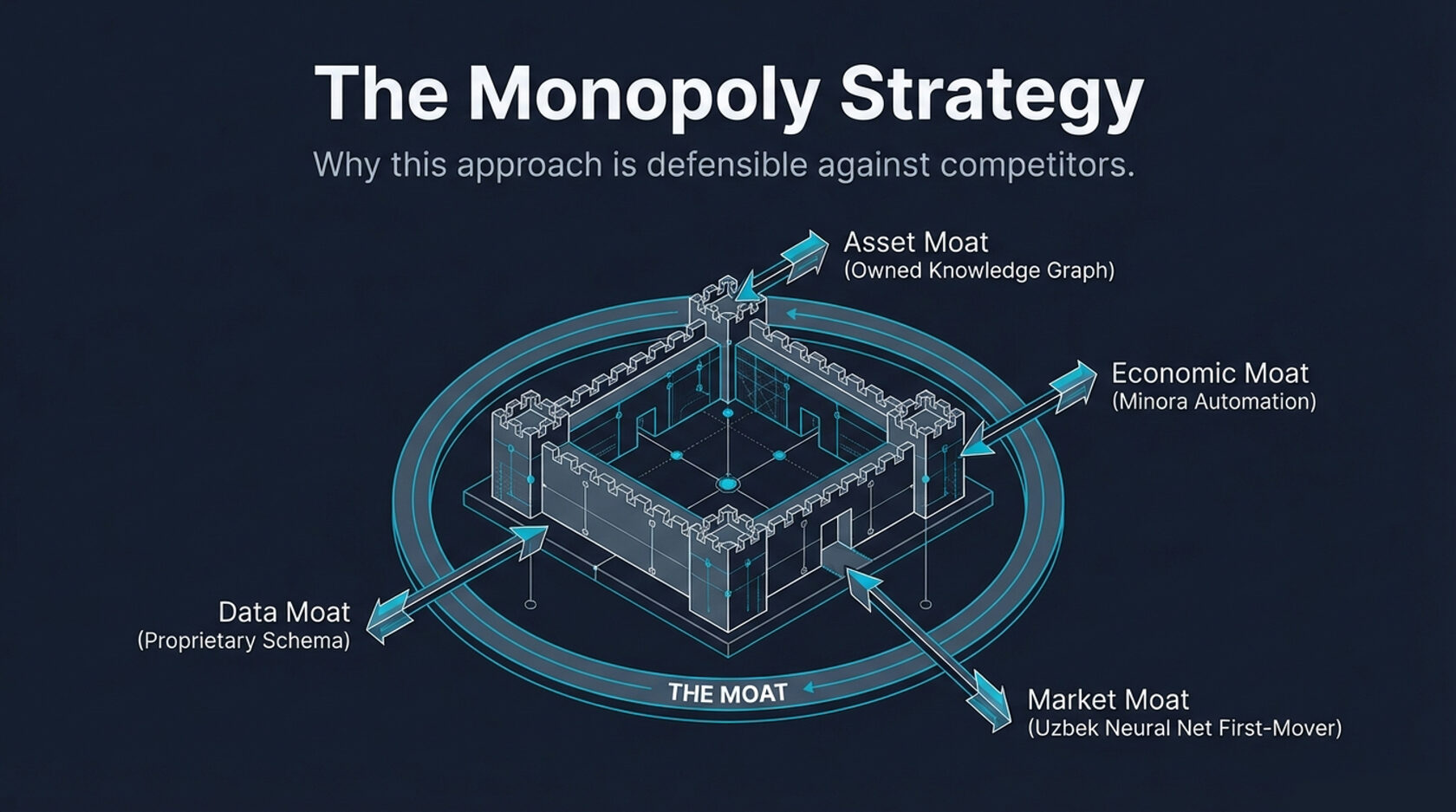
Section 8: Uzbekistan Market Nuances (The "Local" Edge)
Strategies cannot be simply copied from US markets to Uzbekistan. Local nuances are critical.
- Yandex Neuro: Yandex's AI search (Neuro) is live and aggressive. It prioritizes commercial factors (trust, delivery info, contacts) more than Google. If a "Contact Us" page is thin, Yandex demotes the site.
- Language Duality: Brands must have dual-language support (Uzbek/Russian). Yandex's new neural networks are specifically trained on the Uzbek language. If the Uzbek version is low-quality auto-translate, visibility is lost.
- Mobile-First Infrastructure: With 94% mobile internet penetration, the site must be a Progressive Web App (PWA) or a blazing fast mobile site.
Conclusion: Stop Burning, Start Building
The era of "budget burn" is a choice, not a necessity. By continuing to funnel capital into inflated ad auctions without an underlying asset strategy, brands are merely renting survival.
The data from Azma Finance and Muna Media proves that a focus on Entity Authority, Technical GEO, and High-Utility Content delivers compounding returns. This strategy builds assets that appreciate in value as AI becomes the dominant operating system of the internet.
The imperative is clear: Structure your data, define your entity, and automate your spend.
Do not let the AI revolution leave you as a "legacy" brand.
Alisher Alimov
Founder, Muna Media & Minora AI
Ready to audit your brand's visibility in the AI era and stop the budget burn?
Start your AI Visibility Optimization journey with Muna Media today:
https://munamedia.me/ai-visibility-optimization-geo-aeo
Detailed Report Expansion
9. Advanced Technical Implementation: Deep Dive
This section expands on the specific technical protocols for engineering teams to implement the GEO framework.
9.1 Yandex MatrixNet and Neural Matching
Understanding Yandex's architecture is key. Yandex uses MatrixNet, a machine learning algorithm that builds a ranking formula based on thousands of factors.
- Palekh & Korolyov: These are Yandex's neural matching algorithms (similar to Google's RankBrain/BERT). They match queries based on meaning, not just keywords. Korolyov analyzes the entire page, not just the title.
- YATI (Yet Another Transformer with Improvements): This is Yandex's massive transformer model. It understands the nuances of the Russian and Uzbek languages better than almost any other model. To optimize for YATI, content must be semantically rich and natural. Short, thin content is devalued. Long-form, comprehensive guides (like Muna Media's "Outdoor Advertising Guide") perform best because they provide enough context for the transformer to "understand" the topic depth.
9.2 The "Commercial Quality" Signal in Yandex
For B2B and E-commerce in Uzbekistan, Yandex applies a strict "Commercial Quality" filter (ICS).
- Trust Elements: You must have a physical address, a landline phone, and official business registration details (INN/OKED) visible on the site.
- Product Cards: For e-commerce, product pages must have detailed specs, prices, and "Buy" buttons. If the price is hidden ("Call for price"), Yandex downgrades the page.
- Customer Service: Live chat widgets (JivoChat, Telegram bots) integrated into the site are positive ranking signals for Yandex as they indicate active business operations.
9.3 Telegram as a Search Signal
In Uzbekistan, Telegram is not just a chat app; it is the internet. Yandex indexes public Telegram channels.
- Strategy: Create a public Telegram channel for your brand. Post summaries of your blog content there with links back to your site.
- The Loop: Traffic from Telegram to your site is seen by Yandex Metrica (if installed) as a high-quality social signal. High engagement on Telegram often correlates with faster indexing and higher ranking in Yandex Search.
9.4 Vector Search Optimization (Technical)
To win in Vector Search (used by RAG systems like Perplexity), you must optimize for "Semantic Proximity."
- Embeddings: When an LLM reads your content, it creates a vector embedding (a list of numbers representing meaning).
- Optimization: To ensure your embedding matches a user's query embedding, avoid jargon unless it is industry standard. Use clear, logical headers (H1, H2, H3).
- Context Windows: LLMs have limited context windows. Place your most critical "Answer Block" content near the top of the page. If the answer is buried in the footer, the RAG system might miss it during the retrieval phase.
10. The Economics of Automation: Minora AI Deep Dive
Why is automation non-negotiable in 2026?
10.1 The Limits of Human Media Buying
A human media buyer can manage perhaps 3-4 campaigns effectively. They can check stats maybe 3-4 times a day.
- The Gap: Ad auctions happen in milliseconds. Consumer behavior shifts in minutes. A human reacting to yesterday's data is already too late.
- Fatigue: Humans suffer from decision fatigue. After optimizing 10 ad sets, the quality of decisions drops.
10.2 The Minora AI Advantage
Minora AI operates on a different substrate.
- Real-Time Execution: It checks bid/budget distribution every few seconds.
- Predictive Modeling: It doesn't just look at past ROAS; it predicts future performance based on trend lines. If a creative is trending down, Minora kills it before it burns significant budget.
- Cross-Channel Intelligence: It sees that a user clicked an ad on Meta but converted via Google Search. It attributes value correctly and adjusts bids across both platforms, preventing double-counting and wasted spend.
10.3 The "CFO-Ready" Promise
For the CFO, marketing is often a "black box." Minora AI turns it into a transparent engine.
- Stable CAC: By aggressively cutting waste, Minora creates a predictable CAC floor.
- Scalability: You can scale spend from $10k to $100k without hiring 10 more media buyers. The AI handles the complexity scale.
11. Final Recommendations for Uzbekistan Founders
- Audit Your "Entity": Go to Google and Yandex. Search for your brand name. Do you see a Knowledge Panel? If not, you are in danger.
- Invest in "Utility" Content: Stop writing "news." Start building tools (calculators, lookups, definitive guides). Look at Azma's IKPU tool—that is the gold standard.
- Adopt Automation: If you are spending more than $5k/month on ads, you need automation. The efficiency gains (often 20-30%) pay for the tool itself.
- Think Bilingual: Your Uzbek content must be as good as your Russian content. The demographic shift is undeniable.
The future belongs to the Brands that act as Entities, not just advertisers.